Episode 349: EXPERT STACK Hidden Toxins in Modern Daily Life
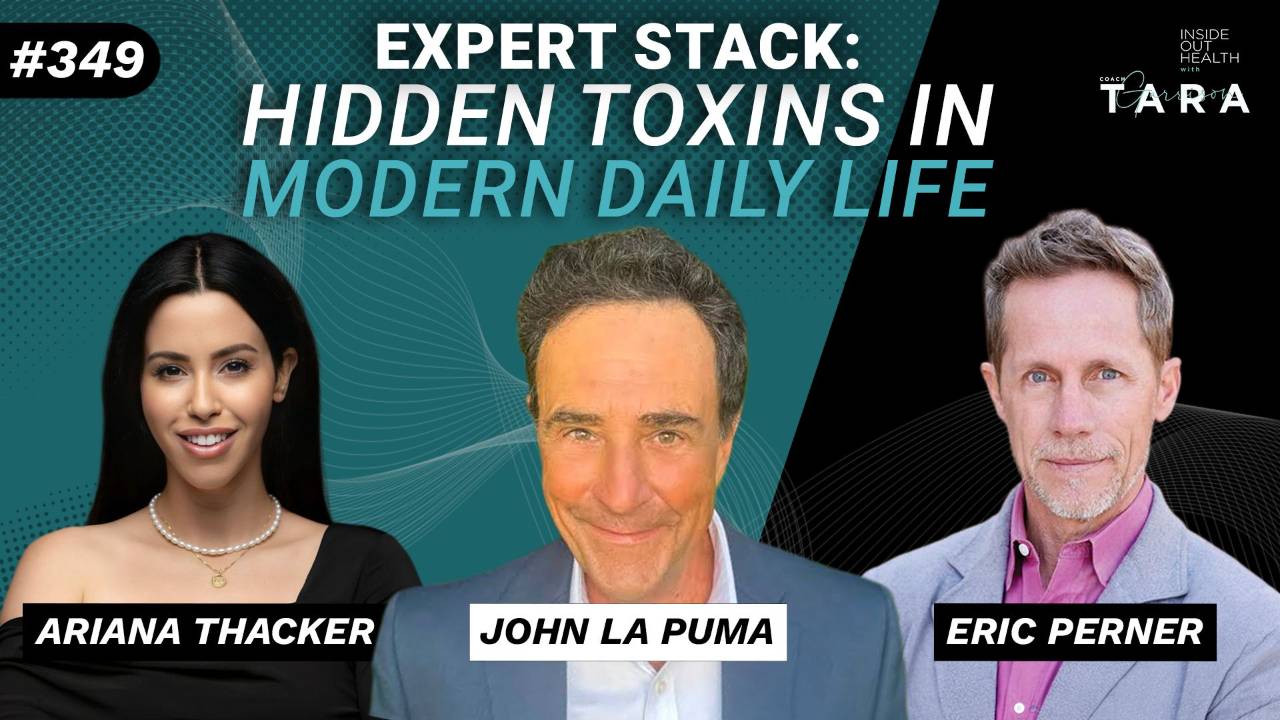


In this episode, Tara talks with mold expert Ariana Thacker, indoor-living researcher Dr. John La Puma, and regenerative rancher Eric Perner about the hidden environmental exposures shaping modern health.
Ariana Thacker is a chemical engineer, venture capitalist, and the founder and CEO of MoldCo, a health-tech platform addressing mold toxicity. After co-founding Conscience VC to invest in science-driven startups, Ariana launched MoldCo, inspired by her own health journey.
Eric Perner spent most of his early life and career on horseback learning the craft and trade of equine athletic competitions at the highest level. Eric owns the Double P Ranch in Mounds, Oklahoma where they produce grass-fed beef, goat, lamb and pastured pork as part of the supply chain for REP Provisions. He operates his ranch as a Savory Global Business Hub to provide restoration grazing education and guidance for other local ranchers in the methods of holistic management to create the conditions that lead to the regeneration of our native grasslands.
John La Puma, MD, ChefMD™ is a two-time New York Times bestselling author, board-certified internist, and professionally trained chef who pioneered Culinary Medicine. He now pioneers EcoMedicine from his small regenerative teaching farm. His upcoming book, Indoor Epidemic, reveals how spending 93% of life indoors steals sleep, focus, and years, and how reclaiming just 7% outdoors can restore them using the evidence-based Outdoor Rx framework.
RESOURCES:
- Learn more about Ariana here: https://go.moldco.com/tara-garrison
- Ariana's Instagram: @themoldcompany
- Full episode with Ariana: https://www.taragarrison.com/blog/arianathacker
- Learn more about Rep Provisions: Vote for the future of food with your dollar! And enjoy a 15% discount while you're at it with Coupon Code COACHTARA: https://bit.ly/3dD4ZSv
- Eric's Instagram: @repprovisions
- Full episode with Eric: https://www.taragarrison.com/blog/ericperner3
- Learn more about Dr. John: https://www.drjohnlapuma.com/
- Full episode with Dr. John La Puma: https://www.taragarrison.com/blog/drjohnlapuma
CHAPTERS:
00:00 – Hidden toxins in modern daily life (intro)
01:09 – Ariana's mold story & symptoms
02:55 – Failed by standard care, diagnosed, and founded MoldCo
04:36 – Scale of the problem: 25–50 million Americans affected
05:56 – Why doctors miss mold as the root cause
08:15 – How MoldCo tests and treats patients
09:52 – Why mold makes some people sick, not others
11:38 – Tara's mold-in-a-car story
14:08 – Patient outcomes: 78% symptom resolution
14:52 – What indoor living does to your body
16:54 – Tara's own light-starved waiting room story
18:15 – The myopia epidemic and the eye-distance fix
20:59 – Screen burnout, front porch resets, and "digital obesity"
23:41 – The 17-minute minimum dose of nature
26:04 – Light as nutrient: circadian clocks and indoor air
28:58 – Nature is everywhere: small daily connections
30:25 – Why regenerative agriculture matters in 2026
32:34 – Biodiversity collapse: the WWF's 70% stat
33:58 – Vanishing wildlife and our disconnection from nature
WORK WITH TARA:
Are You Looking for Help on Your Wellness Journey? Here's how Tara can help you:
- CHECK OUT HIGHER FITNESS APP: https://app.taragarrison.com/
- INDIVIDUAL ONLINE COACHING: https://www.taragarrison.com/work-with-me
- CHECK OUT HIGHER RETREATS: https://www.taragarrison.com/retreats
SOCIAL MEDIA:
- Instagram @coachtaragarrison
- TikTok @coachtaragarrison
- Facebook @coachtaragarrison
- Pinterest @coachtaragarrison
INSIDE OUT HEALTH PODCAST SPECIAL OFFERS:
☑️ Upgraded Formulas Hair Test Kit Special Offer: https://bit.ly/3YdMn4Z
☑️ Upgraded Formulas - Get 15% OFF Everything with Coupon Code INSIDEOUT15: https://upgradedformulas.com/
☑️ Rep Provisions: Vote for the future of food with your dollar! And enjoy a 15% discount while you're at it with Coupon Code COACHTARA: https://bit.ly/3dD4ZSv
If you loved this episode, please leave a review!
Here’s how to do it on Apple Podcasts:
- Go to Inside Out Health Podcast page: https://podcasts.apple.com/us/podcast/inside-out-health-with-coach-tara-garrison/id1468368093
- Scroll down to the ‘Ratings & Reviews’ section. Tap ‘Write a Review’ (you may be prompted to log in with your Apple ID). Thank you!
EPISODE TRANSCRIPT:
What if some of the things impacting your health the most aren't coming from your diet or your workout routine, but from your environment? Today's episode is all about the hidden exposures built into modern daily life that most of us rarely think about. We're starting with mold toxicity, including why someone can feel absolutely terrible while their standard labs can come back looking normal, and how common water-damaged buildings actually are, and what recovery can look like when you finally identify the problem is mold.
And then we're talking about something I think most of us underestimate, um, which is spending the majority of our lives indoors and what that is actually doing to us. Finally, we're gonna get back to where our food starts, and we're gonna talk about the soil and look at how modern chemical agriculture has changed the nutrient cycle, and why regenerative farming isn't just an environmental conversation, it's actually a human health conversation.
So these are three very different topics, but they all come back to the same idea, is that our bodies are not separate from our environment. So let's go ahead and get into the show. Let's start with, uh, just a bit of your own journey. Why is this even a thing that you're involved with?
Yeah. So I was a patient first, um, I, I say quite serendipitously now versus unfortunately. So I had mold in my Miami unit, uh, got quite sick due to that exposure, and then, uh, pivoted my life to help other patients with this. I believe it's one of our biggest medical blind spots.
Yeah, absolutely. I, I bet a lot of people listening today are you guys are gonna get a a paradigm shift. Okay. So let's use you, um, as an example, and then we'll kinda juxtapose to many other people. But what were you experiencing symptom-wise?
Yeah. Um, I would say I was experiencing the very traditional Shoemaker symptom clusters, if, if you're familiar with that. So, um, it shows up as brain fog, uh, cognitive issues. I remember having to reread my emails multiple times, for example. Um, processing issues with even, um, audio visuals, so, um, I would have my friends repeat what they were saying to me just so I can, um, totally comprehend what they were, um, sharing.
Uh, gastrointestinal issues. So a lot of patients, um, like me, I had experienced, um, what felt like IBS, so, um, like just not being able to process food as I normally would. Uh, sleep issues. remember having night sweats, not having great sleep, uh, fatigue. So I really had to manage my energy during that time.
Like I, I felt like I had a few, uh, really functional hours in the day, and the rest of the day I was like in bed doing Zoom calls and just kind of recovering. Um, hair loss and a whole host of other issues. So I, I listed so many because it's not just one acute symptom, it's actually multiple symptoms that present that impact many parts of the body.
So what did you try from there? What was your idea of how to get out of the situation you were in?
Yeah. Um, so pre-discovering mold, I went through standard medical care, like went to my PCP, went to multiple specialists, did a whole battery of lab testing and some imaging, and largely that showed up as normal, and my, uh, doctors and specialists were perplexed. Um, like full transparency, I did have low iron levels, but it didn't really, um, didn't really justify the symptoms I was experiencing, and taking iron pills didn't help the issue.
Uh, it wasn't until after I discovered it was mold, I, um, actually went more functional health and alternative medicine and, um, worked with a Shoemaker certified provider and got back to better health. So, um, that, that specific MD tested me for, um, markers unique to the biotoxin illness pathway, so those are the Shoemaker, um, lab tests, like MMP-9, MSH, TGF-beta1, and these labs were, uh, quite dysregulated.
And then, um, went through, um, the Shoemaker protocol, so starting with a prescription binder. Um, usually there's cholestyramine or colesevelam. I, uh, went with colesevelam and, um, et cetera. Um, just went down that journey and, uh, got back to better health.
Wow. How many people... So, well, hold on before I ask that. Like,
Yeah
where has your journey taken you from here? Can you tell us about what you've created to help people with this since then?
Yeah. Um, originally, um, went down this rabbit hole just to get better, like wasn't trying to start a company. and then I started, uh, talking to a lot of my friends and even family members that had their own personal mold journey and realized, wow, you know, so many more people are impacted by this than I thought.
And my best guess for how many people are impacted, um, we, we actually published an economic impact report. It was roughly 25 million Americans, adults and pediatric, um, patients severely impacted, like to the level of chronic inflammatory response syndrome.
Wow.
And our best guess is up to 50 million, um, moderately to severely impacted. So, um, I, think this is a really big issue, uh, bigger than we've realized before in healthcare, mainly because so many homes are impacted by mold. Uh, there's been multiple studies that corroborate around 50% of homes have some level of mold, water damage, and dampness.
Um, we've seen estimates as high as 70%, even we know 85% of commercial buildings have had historic water damage, 45% ongoing water damage. It's considered the number one issue on the military bases. So there's just a lot to support that exposure is happening, and there's even more and more evidence to support the health impacts are, um, bigger than just, uh, respiratory, um, asthma, um, allergies, and fungal infections.
Like it, it's, it is this inflammatory response. And finally, the NIH recognized that too. Um, so the NIH updated their mold page to reflect the immune, um, disruption that happens, inflammation, and even mental health issues that, um, result
So, yeah, so okay, so then it, that's progress. Um, but still currently in 2026, you know, if you go to the doctor because you're having mood stuff or brain fog or gut issues or whatever, it's likely to be not, that's not the route that they're gonna go currently in our current medical system, right?
You're a yeah, you're 100% right. Like, you're you're more likely to get referred to a, a psychiatrist or
Right
psychologist, um, if you're experiencing anxiety or depression. Um, we even see suicidal ideation, um, fairly common in, in this patient cohort. Um, and unfortunately, the root cause issue just never gets addressed.
Mm-hmm.
It's, um, mainly at the like, what is your most acute symptom? You're probably gonna get referred to that specific specialist to try
Right
address very acute, uh, symptom. Yeah.
Right, and this one's not gonna be they're probably not gonna refer you to a mold specialist. You know what I mean? So it's just, I think
Yeah
hidden from so many people. I think so many people haven't even really heard of it, right? Like, they're it's still pretty on the DL, mold, mold-related illness.
I, Yeah, I, I would say very much on the DL. Like, as a, as a company, we're trying to shift that in a, in a very meaningful way.
Mm-hmm
we've been producing a lot of content. Um, you know, I've, I've been, um, spending lot of time on podcasts too and writing content.
Mm-hmm.
And, um, like really leaning on our clinical team to share our insights, and we're also advancing research in the space. So we've amassed what we believe to be the world's largest data set in the space of thousands of whole blood samples and detailed patient
Mm
really understand how this illness impacts human health, and then also publish those insights so it's open and available to other, um, clinicians and scientists outside of this, like, smaller community of, um, doctors in the Shoemaker circle.
That's amazing. Yeah, so tell us, uh, just 'cause now people, if they're having some of these symptoms, they're probably like, "Okay, so what, like what, what do you do?" So first of all, your social media is really great. I'm like, "This is a lot of followers for a mold, mold company."
Thank you.
so lots of great info. I mean, as soon as I started thumbing through, it's like these are the labs that we test. This is what they mean. This is all, you know. So great info on your Instagram, by the way, if anybody wants to check that out, and we'll link that in the show notes.
Mm-hmm.
but you know, in, in terms of how you're helping people, can you talk a little bit about how that experience goes for people?
Yeah, absolutely. Um, I like to think of it as three core problems we're solving. So answering the question, am I being exposed to mold? We have an environmental DIY test for your home. Uh, answering the second question, is mold making me sick? So we have blood-based biomarker testing, which is available at LabCorp, which just makes it so much easier.
Mm-hmm.
and then the third question, um, we answer is how do I get better? And for that, we have concierge care, uh, with our specialized and trained providers. Um, they're all trained under the world experts in, in the space, so Dr. Shoemaker, Dr. Scott McMahon, and, um, others on our team.
And then we also ship the medications that are prescribed directly to patients' doors as well. And we've delivered that experience at about a 10th to 100th the cost of status quo. Um, so working with these, like, brick-and-mortar, um, providers, which they normally have multi-month wait lists. There's normally, um, a high, um, barrier to entry from a cost standpoint, and you're not ever really gonna get that hands-on, um, concierge care where you can DM your clinical care
Mm-hmm
um, with our average response time right now being around two hours. So, um, just a very, like, hands-on approach to getting patients better through every step of the journey. And soon we'll also be layering on more on the environmental side because, like, just navigating how do I find a home inspector, how do I find a remediator, what's the right next step for me on the environmental side is also fairly treacherous.
Mm-hmm. Yeah. Yeah, and you can do this all virtually too, which is nice, on your website, right? It's like, okay, cool.
Exactly.
Very accessible.
Yeah.
It's awesome.
Thank you.
So okay, next big thought that's probably going, maybe going through people's minds is, like, okay, well, if there's mold in this many homes, then how come not everybody is having all these symptoms? Can you talk about that?
Absolutely. Yeah, so there's a few, um, pieces to the recipe there. So one, there is a genetic susceptibility, um, to this illness, and that's actually something our research, uh, team has mapped out, and it's called HLA haplotype testing. So that's what we do. Um, roughly 24% of the US population has an HLA haplotype to make them more susceptible to exposure.
Um, what that means more specifically is that roughly 95% of CIRS cases that we've mapped end up having one of these genetic susceptibilities. So it's fairly high signal for who gets, um, sick in the environment. And beyond that, um, there's a lot that goes into, um, who gets sick beyond the genetic susceptibility.
It's how much time are you spending in the mold environment. For example, if it's in, um, your, your bedroom and it's not in your housemate's or roommate's bedroom, they're, um, less likely to get sick from that exposure. Um, if you're living in the home and you're already immunocompromised, you're more likely, um, to get sick, or if you've, um, uh, have, have had poor health or, um, poor habits in general, right, that makes you just a lot more susceptible to that.
So, um, I would still say we're at the early innings of mapping out who exactly gets sick and the reasons why they get sick, but, um, our best, um, our best information today is really this HLA haplotype, um, known exposure that's nearby and, um, acute and also, um, for a long duration.
And also, um, specific types of mold hasn't really been that mapped out. We know some molds are more problematic than others. For example, we, um, test for the top five and soon-to-be ten inflammation-causing molds that we're aware of, but there's so much more research that's needed in, in that space.
Hmm, okay. Yeah, and you're making me think. I had this client one time that she... I mean, she had been working with a very well-known doctor. He's very out there, and I know him personally, and he's, uh, awesome, and, you know, she was in his group and all this stuff, and then she's working with me, and I'm like, "Man, something is seriously wrong." Like, I, uh, she got an unbelievable stomach bug and was puking and nonstop for, like, a week, you know, diarrhea, all that.
And she's like, "I didn't lose a single pound, by the way." She's like, uh, and I'm like, "That's weird." You know? Like, not even water? Like, okay.
Wow.
Something's really going on with her physiology. And then she kinda, like, disappeared for, like, a couple weeks. I'm like, "Hey," like, "you good?" Like, like, "Shoot me a check-in or something." And she's like, "I am so sorry. I... So I got in a car accident, and my car got totaled, and, um, we discovered that the whole underneath, like, that fabric on the top of my car, there was tons of mold." Like, I'd had some sort of water...
Oh, sorry. It wasn't an accident. It was her car got, like, mechanically totaled. That's what it was. Because it, like, broke, and so when they were, like, looking for that, like, they found that. And she's like, "I am in my car for hours, uh, commuting every single day." So just throwing that out there in this station, like who would have thought?
Mold in her roof of her car. You probably see that stuff.
That, I would say that's one of the more underrated places to look. Like, we spend, spend so much time and attention in the home, uh, less so, um, the workplace, school place, and especially the car, and it could be, um, in the air fired in, in the car, the air purgers more specifically.
Um, so there's just so many different point sources for this. Um, like absolutely, especially if your car has had water damage before, um, like if there's a known flood and there's water
Yeah
and didn't completely, uh, dry out and nor do you have an automotive expert look at it and make sure there wasn't microbial growth. There's so many different point sources that this can come from.
Mm-hmm. Mm-hmm. So can you tell us some of the experiences people have had, you know, just a little bit of a highlight reel of just to make this relatable to people of like what they're experiencing, you know, what they found out, what they did, and like what was the outcome?
Yeah. Um, I'd say every patient journey is, is a bit unique, but, um, the pieces I see in common, um, one are, I can just speak to our, our specific numbers and our, our patient cohort. So, um, the average patient comes to us with 27 symptoms on average at, at intake.
Um, somewhere between 90% and 95% of our patients see some improvement in the first 30 days, so that's hopeful. And some of these patients are still in environment. They're not in a completely sterile, um, home, nor is that ever really the goal. It, it's really challenging to be in a completely sterile environment, and from a remediation standpoint, that's quite expensive.
Um, so it's finding that acceptable limit, um, to, to where you feel good in your home. And within the first, uh, seven to eight months of care, what we typically see is around 78% symptoms resolution, meaning the patients that are, um, reporting symptoms no longer have the symptoms that they're reporting.
What is actually happening to our bodies when we're inside all the time?
Two things. One, we have a low level of chronic inflammation, almost all of us, especially when we're in sealed environments like buildings that are newer or schools that are newer or offices that are newer, and those sealed environments seal in a lot of chronic toxins that are circulated in the air that we kind of take for granted, everything from sprays for household needs to flame retardants to dust and mites and molds, and those all affect our biology a little bit by raising our C-reactive protein levels and our chronic inflammation levels, and many chronic diseases are inflammatory as an underlying etiology or cause.
Heart disease, diabetes, arthritis, uh, even dementia is thought to be primarily an inflammatory disease in some forms. The other thing that's happening is a, a deprivation, and I'm interested in fixing that deprivation. We're depriving ourselves of the natural inputs that change our biology and make them function optimally.
Mm-hmm.
What I'm talking about is natural light, natural air, and natural movement, which means outdoor light, outdoor air, and outdoor movement. Most people don't know that it's 25 to 50 times brighter outside than it is inside, and that you need that bright light at just the right moment to set your body clock so that a lot of good things happen that people just chalk up as not happening because they're stressed or because they're getting older or whatever, but it's actually a combination of these two things, that you're chronically inflamed because you're inside and because you're missing the circadian input that bright light and that, uh, outdoor air and that natural movement outside, green exercise, gives you.
Thanks for that. Let's hit on people. So right now what I'm, what just crossed my mind as you described this was, um, I was at my son's therapy appointment. It's a new therapist and, you know, been a few times, and I'm sitting in this waiting room, and there's no windows, no natural light, just office lighting, and I, because I'm not used to that, I work from home, we have lots of windows in here, I'm just used to kind of that when I am indoors, like I could, I couldn't bear being in there.
Like, I was like, "This is making me feel-" horrible." Like
Yeah
so I just went in my car and texted my son. I'm like, "I'll be in the car." Um, so for people listening, you know, they're like, "Wow, that would be nice, but I work in this environment that that's how it is. I can't just like up and change my work environment," you know, what kind of, uh, recommendations do you have for people like that, that basically work is putting them in a artificial light dungeon for eight hours a day?
Well, you know, I just gave a talk at Edelman PR in New York earlier this year, and it's so important for those people to be inside because that's where you meet other people, you exchange ideas. Being in a, in an indoor environment for people who work together is actually great often because it's more productive.
But what we don't realize often is that that kind of, um, if we do that only, if we're only inside during the day, if we don't get distance for our eyes, for example, our eyes need distance like our lungs need air.
Mm-hmm.
So you ought to go to a window. Open the window if you can. You don't have a open window, then a doorway. If you don't have a doorway, you live in a city, go to a fire escape, anywhere you can actually see distance. What you need is a sky view, not a forest.
You only need a sky view, and if you don't have a sky view or you can't see out, you can then look at the furthest roof, rooftop you can, the furthest rooftop you can see, because your eyes on working on screens, which most of us do every day, have a very limited function.
We just look here. And looking just here is only eight inches away, or here, which is 24 inches away, and that actually changes the shape of your eye. It elongates your eye, and that's why one of the core reasons that myopia or nearsightedness develops. In Singapore, myopia is 90% of the population, and there are public health posters and campaigns everywhere for kids to get out and play two hours a day with their parents and get off their devices, because that is changing their eyes.
And in California, where I live, myopia is about 40% prevalence. And myopia, not so bad, eye drops, glasses, but about 5% of myopia is high myopia, which can result in severe eye damage and actually near blindness in your 30s or 40s. And we don't need to take that chance.
One out of 20 people get high myopia. So you can alleviate, reduce the risk for it by looking in the distance a minute, an hour, and actually stall it by looking in the distance five minutes an hour at a window, and you can look through the window for that, um, but not for the morning light part of it, but through the window, a distance, rooftop, sky view.
Relax the ciliary muscles around your eye, reduce the headache and fatigue, and let your eyes use distance as the medicine they need to reset, and then you can go back to cognitive function. Your brain is actually being restored during that time because you're kicking in other systems. Not only are you helping your vision, but you're helping your parasympathetic system kick in and rest a little bit and getting away from the fight or flight feeling that so many of us have when we have notifications and texts and things to do.
Mm-hmm. Yeah, thanks for that. Yeah, being totally honest, that's one of my biggest challenges with doing podcasts.
Yeah.
Because I'm very active. I'm probably somewhere on the ADHD spectrum for sure, and I'm very And, and it's not like me to be staring nonstop at a screen for an hour straight. It's something I've really... I actually have these, uh, these computer glasses I was gonna wear, but they were just too dark today, and I just couldn't do the look, but, but,
But I mean, uh, the distance will help.
Mm-hmm.
mean, I don't know if it's part of your routine to go to a window, to go to a doorway, or to go
Well, got one right here. So if I just start going like this, you guys know what I'm doing.
But yeah. But I mean, I would do it deliberately a
Yeah
an hour.
Yeah.
Or if you have myopia and you want to try to stall it or... And then go out five minutes an hour. And then what you're doing when you're looking at the sky or you're looking outdoors is looking for difference in variations or patterns. You're looking at different colors.
Mm-hmm.
If you're lucky enough to see green, then you're seeing different shades of green. You're seeing the wind move the leaves. You're
Mm-hmm
kinds of patterns in the trees, if you have trees, which are actually more relaxing to your brain than pixels on a screen. And for so many of us, you know, like too much sugar burns out your metabolism, too many pixels burn out your brain.
Mm-hmm.
That's what I call digital obesity, that kind
Mm
burnout. But it's actually not that you're burned out. You're simply indoors too much, and your brain a break allows your brain to restore itself and pay attention again.
Mm-hmm. Yeah, and it doesn't take much. What I've my front porch is right here next to me, and I just, I just go sit on it for a little while. And you're right. Like, I mean, everyone's experienced this, but it's just like when you're looking, you're hearing the wind, you're hearing birds, you're seeing little bugs flying around, and you're...
Like, there's something so calming and healing, right? So that's... even just doing something like that, I appreciate that advice. And, you know, just throwing it out there also, my sister is a big outdoorsy person, like backpacker, hiker, nonstop, but she also works in a factory. She lives in Minnesota, works in like a snowmobile factory.
Mm.
She's the leadership there, and it's all indoors. And so she drastically notices the difference because she so much time in nature. And so her, her, like her, uh, lens of seeing life through, she's like, "I have to-"
Yeah
"have nature time as a top priority on my days off-"
Right
"so that this doesn't negatively impact me long term."
That's right.
Yeah.
Yes. And it's actually easier in many ways, this kind of habit, and we've identified in the research that I did, that you need a minimum effective dose of 17 minutes a
Okay
of deliberate time in nature, in a green or blue space
Okay
where you, um, reset your brain. Uh, but where you spend that 17 minutes and when you spend it and in what ways are, is almost as individual as people are. And, and I go into this in some detail in the book. There are 250 different ways to spend time outside to improve sleep and focus and memory and mood and immune resilience and insulin resistance and insomnia.
Um, and, and yet the amount of time that we need to spend deliberately is very small to achieve a clinical response, to change our own biology. It actually optimizes out at 43 minutes a day if you do it deliberately. Right now, we're spending an hour to an hour and a half a day outside, but almost all that time we spend outside, unlike your sister, is incidental.
For many people, it's walking to the store, walking to a car, going down the block to get a coffee or to meet a friend, but that time is not biologically restorative. It doesn't do anything for our mood or memory or focus or immune system or cardiovascular system. Maybe a little bit if you're walking, but not much.
What we wanna do is use, um, the outdoors in a deliberate way so that we can improve each of those systems and know that we can be deliberate in how we use outside because it makes a great deal of difference to our mood, to how we interact with people, how well we
Totally
how well we do our jobs, what kinds of partners we are, what kinds of relationships quality we have.
Mm
most people, again, just chalk this up to, "Well, I'm having a bad day," or too much stress You know, I'm getting older, so I can expect to not feel well all the time or to have my sleep interrupted all the time, or to need coffee to get going in the morning.
But you actually don't. That's actually not the issue. What's the issue often is that your biology is not getting the right inputs.
Mm-hmm.
And we've left behind the idea of light being an input. Our brains metabolize light like it's a nutrient.
Mm-hmm.
You know, we need it to set our body rhythm. Um, and not just our body rhythm, but the clocks in each of our organs, which is the current leading theory of aging, that each of our body organs has its own clock. And because about 50% of genes are circadian controlled, are active at an, at a specific time of day and produce one protein at a specific time of day instead of another.
We have more control than we think.
Mm-hmm. Yeah. Yeah, I like how you highlighted, like, restorative, having the intention of restorative time in nature.
Mm-hmm.
'Cause, yeah, that... My front porch has... It's spring in Utah, so it's really nice right now, and that's just been my thing. Like, even when it's getting dark, my, my boys kinda like it. We'll go sit out there. We're just front porch sittin' like we're Southern or something. Um, and it's, it, it's different.
It's different than, like, going and doing something, and, like, even going for a walk, that's really great. I love that, too, in that you definitely notice the impacts of that. But there's something about just sitting and being and just listening and, like, not having some other agenda that is even more impacting that way.
That's right. And indoors also reduces your cognitive function in ways that we don't recognize. We have stale air indoors, for example, what you cited before about being enclosed in a building. There are some businesses now have carbon dioxide meters indoors because CO2 levels rise unless the windows are open, and you can sometimes improve the IQ of a room just by opening a window if you're having a conference or a meeting, because you're getting better quality air indoors and not stagnating with the CO2 that's building up uh, inside that room from the multiple people in it.
And when you're outdoors with other people, that's powerful, and actually I devote a whole chapter to this in the book. You know, social connection is part of nature. nature is social. even you live in a beautiful place in Utah. I'm lucky to live in a beautiful place in California.
But nature is not big open spaces and wide remote oceans and, and the Himalayas, although those are beautiful.
Mm-hmm.
Nature is the, the lettuce in your salad, the dog by your feet, the breeze that ruffles your curtains. Nature can be the houseplant on your kitchen table. It can be... Um, I told you earlier, I made these little coasters which are, um, have seeds embedded in them that are basil, parsley, and chive seeds.
Um, some people ask if I sell them. I don't. I give them away at lectures. When I give talks, I give these away to people, and there are usually lines, because they're so fun. For people who are gardeners, and there are about 71 million of us, this can be a transition for anybody who isn't quite yet a gardener, or even if you just want a, a plant on your, um, bay window or outside your doorstep and you have enough light to grow herbs, and you only need four to six hours a day.
Um, and it's so easy. You plant this in organic potting soil, which has, uh, already lots of mycobacteria and, um, and microbes inside that are healthy and, and cover it with a couple of half an inch of also organic potting soil and water it until the seeds come up.
And there's a QR code on the outside so that you can, um, get those instructions in more detail. But the point is that this connects us with things that are living and growing, and that's part of this, that having the idea that we're connected to nature in a literal way can also improve our nutrition and our metabolism.
But by touching soil, we get benefits that I think people are unaware of.
Why is regenerative agriculture important in our current Earth 2026? Like, you know, what, what purpose is it serving, or what, what is it helping to do, and why is it so needed right now?
Uh, and well, I think it's no secret, um, if you look around, at least in the United States or, uh, around... From a human... Let's just focus on the human health component. I, I would say our outcomes for, um, health in this nation are not great. I mean,
Right
just a fact.
Right.
Right?
Right
you know the stats. I think, what is it, Tara? 70, 60 or 70% of our, um, have... Are, um, are obese or overweight or obese? Or maybe it's higher than
And it's climbing. It's not just
And flat, so yeah, it's not
It's, it's like jumping up. Like
Yeah
type 2 diabetes, obesity.
Type 2 diabetes is another one. Yeah. Um, how many times do you have clients that are lacking a certain nutrient
Constantly. Always.
Yeah.
too.
And so how do... it seems only reasonable to tie that back to our food system.
Mm-hmm.
Right? And so I think that's, that's kind of, um, like one, one component of regenerative farming and ranching. It improves the nutrient cycle. So the ability for plants to uptake nutrients gets broken in a more conventional system. So when there's lots of plowing, you know, there's lots of killing the soil, killing all the organisms that work together, and then they have to...
What do they have to do? They have to add, um, chemically Uh, fertilizers to get the plants to grow. And so that's, you really break that, that nutrient cycle. And so I think that's kind of important for human health, you know? So that's why it's important for human
Mm-hmm
to repair that nutrient cycle so that the foods that we do have are more nutrient-dense. So just from human health, I think that should be fairly obvious. We can improve our health if we have the best food that, that our bodies can consume. Um, number two, I guess the, the second thing, um, I would add to that is if you, if you look across the world, um, you know, the way humans have been operating, um, we're, we're basically collapsing biodiversity.
I think the World Wildlife Fund, um, has estimated that since 1970, I think it's 70% of all species they measure are declining. And, and I see that too. It's not, you know, it's pretty obvious. You take away all the habitat of these species, they're, they're declining over time, and if you draw that out over the next 100 years, that gets pretty scary to me.
Yeah
you know, I don't wanna live on a planet that has no biodiversity or has no beautiful birds that I look out my window that I can see. So I... That to me is a very important piece of it. And I
Mm-hmm
you know, again, all these animals and all that that, that works together to generate more life, to create more healthy soils, to create more food. Um, so that's, that's another reason why I think it's critically important.
Can I interject real quick on that?
please do.
You know how like on scary movies there's like a tidal wave or like something scary's happening and like all the animals just start running and flying away and you're like, "Oh
Yeah
"you better run"? It feels like that to me. It's like all of our animals are rapidly declining and going extinct and we're just like, "Oh well," like no big deal. And it's like
I know
that's scary.
I get it.
That's alarming.
No, and I try to understand why, why do we have that mindset as humanity? And I don't, I don't know, think I have all the answers, but I think part of it is this, uh, what I call a shifting baseline syndrome. Have you heard that term?
No.
Like for example, like if you grew up in a, an earlier time era, maybe the, the '60s or whatever, and you were on a farm and we haven't plowed up, you know, 400 million acres of monocrop. For example, let me give you a good, a good concrete example. When I was a kid growing up, uh, we lived on a farm and we had guys that loved to hunt a species of bird called bobwhite quail.
They're just a awesome bird. They, you know, they're great for meat and, and they would, they, they, they bred hunting dogs to hunt bobwhite quail. And we would let them come and hunt 'cause they were abundant back then. And, um, and now you can't find them anywhere. You... I have 'em on my
No way
but you cannot find... None of the hunters are, have those capabilities. They, they basically, the numbers have dropped so drastically that, that, that the number of hunters that are hunting bobwhite quail is very small now comparatively speaking, right?
Wow.
That doesn't mean there's nothing that doesn't exist. But so if you grew up back then and you saw that decline, you're like, "What?" let me give you another example. When I grew up on my farm, um, in Oklahoma, we had massive numbers of monarch butterflies that would, as they were doing their migration, which they have this beautiful migration from Mexico to Cana and then back to Mexico, we, I continually would see hundreds of, um, maybe thousands of monarch butterflies.
Now it's, it's much more rare. It's much more rare.
Wow.
So I guess if what I'm saying is if you grew up today or, or some period before that decline, you're thinking, "Oh, these animals are still here. They're fine." But your baseline is not what it used to be.
Mm.
You follow me? So if
follow.
If you grew up in the era I did, you see the decline very dramatically and you, and you believe it and it hits you hard. But if you didn't, maybe your, your, your baseline is something different, right? And you just think, "Well, they're still here, so they're okay." But when you draw that out, that line from abundant to at some point it drops below the x-axis and it's zero and it's gone and it just hits you, and you've done nothing about it.
So I think that shifting baseline syndrome is, is maybe one component of us not really getting it.
Well, and also as a representative of all of us, which is most of us who aren't, uh, working on a ranch or
Yeah
there's a complete and total disconnection from this. Like, we have no idea. It's like the people, they, the great they, they grow the food and make the food and they'll take care of everything and do everything right I'm sure, and I just go to the grocery store and buy it.
Yeah
there's very little connection and, and I would say even those of us like me who like to get out and hike and be in nature, it's not the same as living on a ranch where you're seeing thousands of monarch butterflies and you're like, "Hey, now I only see like four"
Yeah.
You know? So I
Yeah
it's also just we're very, very, very
Absolutely
where our food comes from, the cycles of nature. You know, even like during COVID I was, uh, walking around the lake by my house every single night when it was dark and I was like, "Oh, this is why so many of the ancient civilizations like understood the stars and all that," because I'm starting to be able to understand like Venus and its relation to the moon and like how it moves over the sky at night.
And like I... This is just from me doing this for a few months, you know? But we're so disconnected from nature.
that's right.
it, it's all just a mental stat. There's no visceral experiential connection like you're having with maybe the quail or the butterflies. And so it's a high cost of our convenience system that we've created. And I, and I, we all
Mm
our convenience system. I love that I could just go get an avocado right now.
Yeah. yeah.
But if, if we're being real, like I live in Utah, I shouldn't really be having avocados like whenever I want, you know? So it's, it's real nice, but it's also has a steep cost and I think that's a big, big part of it. Thank you so much for joining me on this episode of the Inside Out Health podcast.
I hope it's been helpful to you in your journey. If you think that it might be helpful to someone you know, please share it with them. Please share on social media. It really helps me grow the show and reach more people with these amazing messages. And if you could be so kind as to rate the show and, um, possibly even leave me a review, that really helps.
So, uh, much thanks in advance if you do that. And yeah, please subscribe if you wanna hear more of this type of content. I have lots of amazing expert guests on the way. All right. Thank you.

Want One on One Coaching with Tara?
Click below to learn more about Tara's flagship 1:1 program HIGHER Coaching. Work directly with Tara on training, nutrition, personal development and biohacking!

Try Coach Tara App for 7 days FREE!
Learn how to train for results at home or in the gym, how to make easy, healthy recipes to achieve your goals faster, and explore the world with Tara as she helps spark shifts inside you to bring your best self out!
