Episode 330: EXPERT STACK Out of Fight‑or‑Flight: Brain Retraining, Brain Waves, and Jitter‑Free Coffee
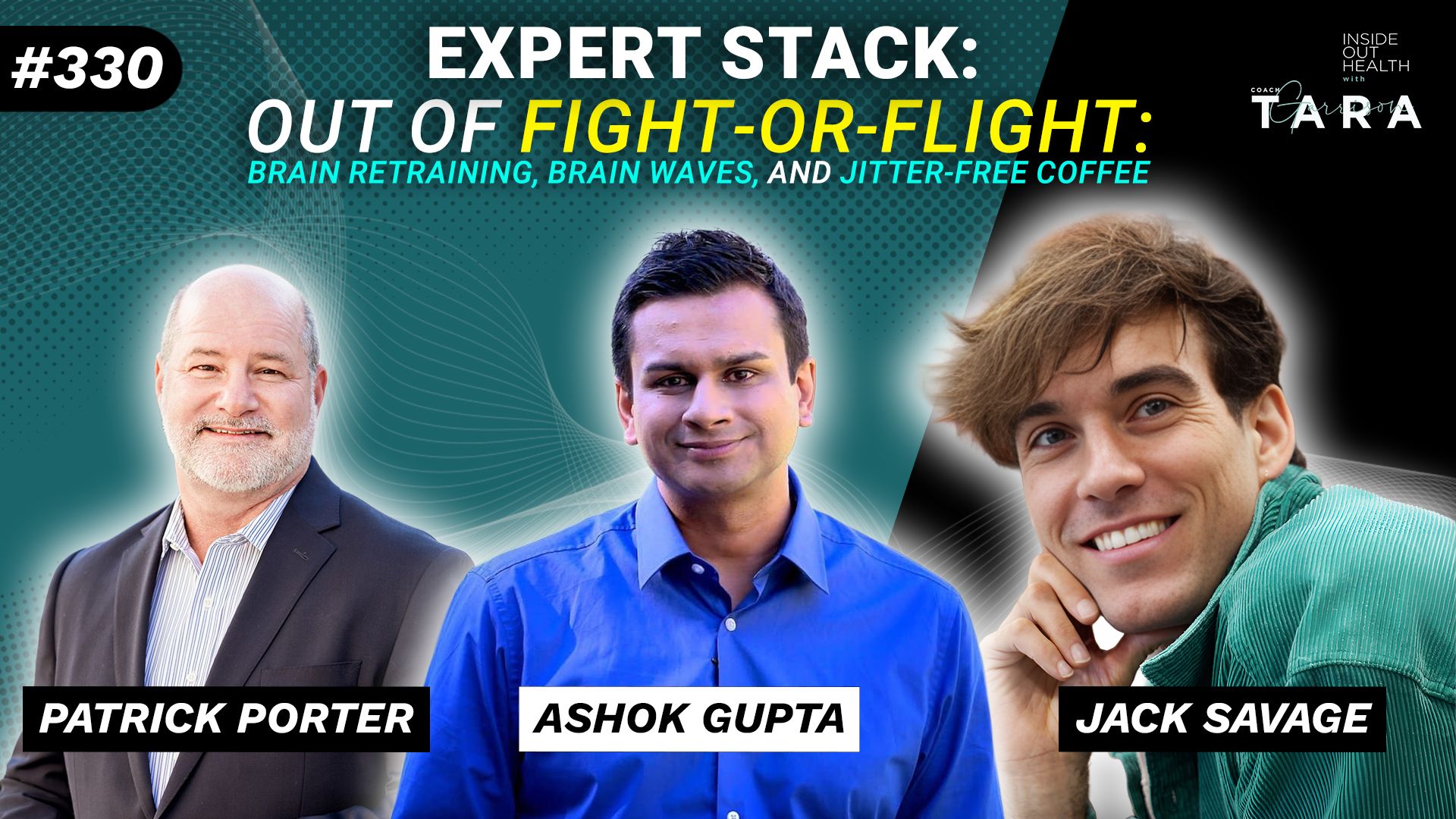


In this episode, Dr. Patrick Porter, Ashok Gupta, and Jack Savage explore with Tara how brain retraining, better sleep, targeted tech like BrainTap, and gentler stimulants with ingredients such as L‑theanine and medicinal mushrooms can calm an overstimulated nervous system and improve focus.
Dr. Patrick K. Porter, PhD, is an award-winning author/speaker and the founder of BrainTap®, the leader in technology-enhanced meditation. Dr. Porter pioneered the use of brainwave entrainment to improve clarity, sleep & energy, and remains at the forefront of scientific research. He founded BrainTap with the goal of making this technology accessible to everyone. BrainTap offers over 1800 original audio sessions in 12 languages and serves a worldwide user base with its mobile app and headset.
Ashok Gupta is the mind behind The Gupta Program and a leading expert in the field of neuroimmune conditioned syndromes (NICS). Ashok is an internationally renowned Speaker, Filmmaker & Health Practitioner who has dedicated his life to supporting people through chronic illness, and achieving their potential.
As someone who’s always had trouble focusing, Jack Savage was prescribed stimulants at the age of 5 until high blood pressure gave cause for serious concern. He quit cold turkey and started drinking lots of coffee. After 1-2 hours of ineffective energy, he’d crash or if he drank too much, he’d feel jittery and anxious. That’s when he started researching biohacking, nutrition and functional mushrooms. Jack found that basically all mushrooms are magical, especially when combined with nootropics. This led him to the ingredients in Everyday Dose, which have allowed him to regain control of his life for the first time.
RESOURCES:
- Learn more about Dr. Porter here: https://www.taragarrison.com/blog/drpatrickporter | Instagram: @braintaptech @drpatrickporter
- Learn more about Ashok Gupta here: http://www.guptaprogram.com/ | Instagram: @guptaprogram
- Learn more about Jack Savage here: https://www.everydaydose.com/COACHTARA | Instagram: @everydaydose
- Get 10% off Peluva minimalist shoe with coupon code COACHTARA here: http://peluva.com/coachtara
- Watch the full interview here:
- Dr. Porter: https://www.taragarrison.com/blog/drpatrickporter
- Ashok Gupta: https://www.taragarrison.com/blog/ashokgupta
- Jack Savage: https://www.taragarrison.com/blog/jacksavage
CHAPTERS:
00:03 – Intro: survival mode and calmer brain
00:23 – Expert stack: Porter, Gupta, Jack from Everyday Dose
04:19 – Sponsor: Peluva barefoot shoes ad
07:12 – Aging and memory, elders and wisdom
08:26 – Pills vs lifestyle: energy, sleep, movement
08:52 – Dementia‑spectrum women’s BrainTap study
10:54 – Diagnosis impact and 3×/day BrainTap protocol
11:58 – Morning SMR, coffee dependence, balance/vestibular
13:26 – Afternoon reboot, HRV, memory and focus
15:27 – Night delta session and flipped cortisol
15:46 – 39% neuroplastic change and “senior moments”
18:19 – Off the dementia spectrum and better balance
18:52 – Seminole College golf team and alpha waves
21:20 – BrainTap app vs headset, light and sound
24:00 – Brazil app‑only study vs opioids for pain
37:20 – Psilocybin‑like gamma patterns with BrainTap
44:59 – Everyday Dose coffee extract and low acidity
45:13 – Lion’s mane, chaga, fruiting bodies vs mycelium
49:35 – L‑theanine in Everyday Dose and ADHD focus
WORK WITH TARA:
Are You Looking for Help on Your Wellness Journey? Here's how Tara can help you:
- TRY TARA'S APP FOR FREE: http://taragarrison.com/app
- INDIVIDUAL ONLINE COACHING: https://www.taragarrison.com/work-with-me
- CHECK OUT HIGHER RETREATS: https://www.taragarrison.com/retreats
SOCIAL MEDIA:
- Instagram @coachtaragarrison
- TikTok @coachtaragarrison
- Facebook @coachtaragarrison
- Pinterest @coachtaragarrison
INSIDE OUT HEALTH PODCAST SPECIAL OFFERS:
☑️ Upgraded Formulas Hair Test Kit Special Offer: https://bit.ly/3YdMn4Z
☑️ Upgraded Formulas - Get 15% OFF Everything with Coupon Code INSIDEOUT15: https://upgradedformulas.com/
☑️ Rep Provisions: Vote for the future of food with your dollar! And enjoy a 15% discount while you're at it with Coupon Code COACHTARA: https://bit.ly/3dD4ZSv
If you loved this episode, please leave a review!
Here’s how to do it on Apple Podcasts:
- Go to Inside Out Health Podcast page: https://podcasts.apple.com/us/podcast/inside-out-health-with-coach-tara-garrison/id1468368093
- Scroll down to the ‘Ratings & Reviews’ section. Tap ‘Write a Review’ (you may be prompted to log in with your Apple ID). Thank you!
EPISODE TRANSCRIPT:
All right. Welcome back to the Inside Out Health podcast. I'm your host, Tara Garrison, and today's episode is all about getting out of survival mode and understanding what it actually takes to create a calmer, healthier, more resilient brain and nervous system in this world that is keeping us constantly overstimulated.
I have some killer guests for you guys today. We're doing an expert stack on this, bringing together some of my favorites on this topic by far. So we're gonna dive into brain retraining and brain waves and neuroplasticity, stress physiology, and even why your morning cup of coffee could either be helping your nervous system or dysregulating it.
Um, so first we have Patrick Porter from BrainTap. He's gonna break down how different brain wave states like beta, alpha, theta, how they affect our stress, our memory, healing, neuroplasticity, and we're gonna get into the science behind brain retraining, which is what BrainTap is, and, uh, I feature these at my retreats, by the way.
I love BrainTap so much. Um, but yeah, how it can help the brain change far more than most people realize. Um, and we also get into how chronic stress patterns can literally reshape our brains. Um, then we're gonna hear from Ashok Gupta. I don't know if you heard this original episode, but it's so incredible.
Um, he's talking about practical tools for retraining the brain and nervous system, um, especially people who are stuck in chronic fight or flight, hypervigilance, that overwhelm, constant go, go, go mode. Um, and finally, we're gonna hear from Jack Savage from Everyday Dose. Um, and I have to say a quick huge thank you to Everyday Dose for sponsoring our Joshua Tree Higher Retreat.
Um, they, they are awesome. What you gotta hear, Jack, uh, I would highly, highly recommend listening to these full episodes, but we're gonna, you know, condense some of the most awesome highlights here in this episode. But Jack, Jack has ADHD, got really sick of feeling jittery, um, very obviously addicted to stimulants, uh, 'cause that is the treatment for ADHD, and he just didn't wanna feel like that anymore.
And so he made this formula for himself, and then he eventually turned it into, um, Everyday Dose. So, um, it is... He's gonna get into why, uh, less caffeine and other ingredients like L-theanine and, um, medicinal mushrooms can really help with brain and focus instead of just cranking the stimulants nonstop.
So, um, let's go ahead and get into it. Whether you're chronically overstimulated or exhausted, wired, mentally foggy, highly anxious, like, there are some absolute gems in this episode to help support your brain and your nervous system in a healthier way. So let's go ahead and get into it. Okay.
Before we get into the episode, I wanna take a moment to tell you guys about Peluva Shoes. So here's what happened. So Mark Sisson... If you don't know Mark Sisson, you should know Mark Sisson, okay? Go look him up and start following Mark Sisson. Uh, Mark Sisson and also Brad Kearns, who have been on the...
He's been on the podcast, uh, few times now, and Mark has also. They are, like, legendary OGs in the health and wellness industry. And, um, Mark, who also started Primal Kitchen, if you're familiar with that brand, um, has started Peluva Shoes. So Peluva means foot glove in Portuguese, and these are minimalist zero-drop barefoot shoes, and they have that five-toe articulation.
I resisted trying these out for a long time 'cause I thought they looked nerdy. I'm just being so real. Um, but after many times of Brad being like, "Dude, just try them, just try them," I was like, "Okay, okay, I promise I'm gonna be honest with you." Yeah, I wear them all the time.
I absolutely love them. I didn't think that the five-toe articulation was really that important 'cause I've been a longtime fan of Vivos and barefoot shoes and still love Vivos too. Um, but wow, like, major difference. Like, I was like, "Okay, now I'm like really actually using my foot the way I was supposed to." So they are awesome.
Um, I told Brad, I was like, "You're right, dude. I love them so much." They're awesome. Um, and then they offered to sponsor the podcast, so thank you to Peluva, and they also offered to give you guys 10% off if you would like to try them out, which I highly recommend.
Um, you can go to Peluva, that's P-E-L-U-V-A.com/coachterra, or you can just use the code coachterra at checkout and get 10% off of your order, and I highly, highly recommend getting some of their toe socks while you're there, because you're gonna need toe socks. All right. Let's go ahead and get into the episode.
People think that we're supposed to, when we age, lose our memory.
Yeah.
Well, this is counterintuitive to all of history.
Mm-hmm.
All the ancient
Right. Lies
got the wisdom with the tribal elders. They didn't go, "Hey, young man, I'm gonna teach you our tribal..." You know, they went to the elders, so you, they have the wisdom. You know, the people say knowledge is power. That's not true. Wisdom is power.
Mm-hmm.
Because you gotta know what to do with that knowledge, right? So that's the elders. But what's happening now is we're, we're really taking the elders and putting them aside and saying, "Hey, this is..." And, and it's it's mostly because people think they're gonna fix their brain with a pill, a potion, or some kind of magic formula.
The reality is we already have the magic formula.
Mm.
The brain needs energy, you know?
Mm-hmm.
So we have to feed the brain. We have to sleep. We have to, you know, do these things. So what BrainTap does, we did a study with, uh, women, 55, 65. They were all on the dementia scale. what
Hold on one second. You did a study on women? Oh my God. I mean people, that's unheard of.
Yeah.
Yay. Yay for you guys.
Yeah. So, um, Dr., um, Kelly Miller wrote a book called Saving Your Brain, and he, he posted the results in that book.
Mm-hmm.
we have the results too, but the, uh, what he showed was-Now, you can get better results if you add more. So with a study though, you can only do one thing, or they'll
Yeah
"Hey, it was this or that." So if you add in the things I said before, nutrition and physical exercise, like when we went on and did the future studies where we had them doing planks and, you know, different things like this, building that is a lot to do with your memory.
You know, you've, you've got to work out the body. The
Yeah
in, in a, a stagnant form will
Yeah
because it's, it doesn't know what to do. It needs energy. It needs a reason for being as well. So what we did with them was we said, "Okay, we're..." They went to their doctor, they were all diagnosed. We did them do the Cambridge Science online scoring test, which
Mm-hmm
mirrors, uh, basically gives you a protocol if they, or puts them into a spectrum, and they were all in the dementia spectrum, and they weren't Alzheimer's, so we didn't want to include those in the study. But these were all women that had cognitive decline. It was noticeable. It was so noticeable, in fact, that every one of them were told, "It's only gonna get worse." They were...
And of course, when you get diagnosed by our medical community, it's like getting one of those scarlet letters. You know, it's,
It's horrifying
every time somebody opens up your medical record, it says it there. So we had them do BrainTap three times a day, and the main reason for this, in the morning, which is the most important time for your sleep. Most people don't realize that, but if you wake up dysregulated, and, and if you're wondering, "Gosh, I don't know if I have a dysregulated brain," well, do you not function till you have coffee?
If that's the case, then you probably have a dysregulated brain. You just slept all night. Why in the world would you need coffee right away?
Right.
Now, I'm not against coffee. I love coffee myself, but you should drink it a little later in the
Yeah, me
when you when you need that lift or something.
Mm-hmm.
And then, uh, so we had them do that morning session called SMR, sensory motor rhythm. This is the one, as you get better looking and more intelligent with age, it's the one that atrophies. So if you're wondering why that happens, it's because that, that... It's normal. It also has to do with your vestibular system.
So like in your case, helping people with balance and things like
Mm-hmm
that's the brain wave. That's why morning is so important.
Hmm.
Now, in the afternoon, we had them do a reboot session. This is one we would have athletes do right after a workout because, you know, you just
Mm-hmm
your body. If you, if you see your HRV, most people are now measuring that, that is actually a sign of your brain because your nervous
Of course
70% of your nervous
Right
your brain. So it's a great way to measure your brain activity is HRV.
Hmm.
And so we had them do a reboot session, one of our brain fitness sessions, which is memory, focus, concentration, all the
Mm-hmm
as if you were... it was, it's like our school program, but it's for everyday users and adults, not just... You don't have to be in school. It doesn't talk about taking tests and things like that. It's just learning and, and memorizing things and recalling. Because the truth is we all have a perfect memory.
It's our recall system. So think about like if you've ever had a computer go
Love that
you take it to somebody to repair, and you go, "Everything's on this. Can you get it for me?" And they go, "You know what? The file allocation table's rotten or, or something's wrong with it. I can't get to
Right. It's in there
something else," and they know to fix it. Your brain knows how to fix it.
Hmm.
So then what we did at night, when you go to sleep, what happens to people, what we found with this dysregulated brain is, at night, if you didn't stay balanced during the
Mm-hmm
night, it really goes off. So now you actually have a cortical, a cortisol response,
Yeah
which is supposed to happen in the morning, happens at night. Then
I'm seeing this so much now too. When we measure PM cortisol, it's starting to become more common. They're just completely backwards on their cortisol release. They wake up low. That's not good. You don't want to wake up low cortisol. You have no energy. You can't focus, and then nighttime, they're like, zz-zz.
Yep. It's becoming increasingly common.
Yeah, so that's what, that's what we've been finding too.
Mm-hmm.
so at night, you do the delta
Mm-hmm
which basically, the morning session, the afternoon... in the evening sessions, I should say, before bed, they take no additional time. You just set your alarm for 10 minutes earlier, if, if you need alarm, and then you just put it on right before you go to sleep.
Mm-hmm.
So you're gonna get those two, in the middle of the day is gonna be the reboot. What we found after six weeks was a 39% neuroplastic change. Now, what neuroplasticity means is your capacity to do work. So as we age, you, you probably noticed in some of the aging population, unfortunately, you give them too many things to think about, they stress out, and they say, "Hey, stop.
Wait a minute. I can't hold all that in my brain when they used to be able to do that, you know? Or they'll say, "I'm having a senior moment," which isn't necessarily true, but it, it happens.
Mm-hmm.
So part of the, part of the equation is to get them to do these mental fitness protocols. Now, what we what happened with this 39% neuroplastic change, when they went back to their doctor, we already had them take the test. We already knew they were no longer on the spectrum.
They, they, they were focused. They did really well. They, they even mentioned, they go, "I don't know what's going on. I seem to have more balance. I need to..." You know, 'cause we did tests with the balance tracker to show that just improving SMR, you do that, their were amazed.
Every one of their doctors said, "If you could've came here like this six weeks ago, I'd have never diagnosed you." And they said, "Well, can you take the diagnosis away?" "No. Once you're diagnosed..." And they're like, "What?" The nervous system changes every 72 hours, so they're giving you a diagnosis downstream that can be fixed.
If you fix what's happening
Mm
you can
Mm
what's happening in the moment. And so, that was a, that was an incredible study. Now, that study is in a bigger study right now in
Mm.
and also in, uh, Seminole College. And Seminole College is one of our research partners. If, if anyone's in Florida, in that area, you can look up their website. we actually have a page for BrainTap there because we helped their girls golfers. These were the female golfers.
Okay.
And we were, we went in... They're three years in a row now, national champions.
Oh, wow.
And so, uh, these are elite athletes, right?
Yeah.
They, they know how to golf. And golfing really, uh, is an alpha uh, alpha brain wave program because even though golf takes four and a half hours to play 18 holes, you're really only playing for five minutes, you know, because the swinging of the club is, you know, 20 or less.
Mm.
You know, so you're... It's all about what do you do during those peak moments of performance. And so we increased their alpha score by 90%. But my most proud was a year ago, they noticed that the female golf team had the highest GPA in the school.
Wow.
So now we're in the middle of doing a full school-wide,
Very cool
program. And this is just with the app, and we're seeing, we're seeing how we can influence these college students, 'cause there's a lot of stress, you know, when you're in
Yeah
and you have to learn and do these things. So that's really exciting. And we have another test going on right now, and I don't know why all these, uh... I think, uh, females in general are more open to change. But the, uh, when we had the Northeastern women's hockey team a year
Mm
we took 'em to the Frozen Four with just using the app.
Wow.
This year, they all have the headsets, so I'm, my fingers
Mm
crossed they're gonna win the national championship.
Wow. Okay.
you're, doing those sorts of studies like that.
That's a question I really wanted to ask you this, too, 'cause I don't know exactly. Like, because, in case you guys don't know, there's a... Obviously, he's referencing there's a headset and it has lights. It has like a little visor that comes in front of your eyes and there's lights, and then there's lights in your ears, and then there's an app that goes with it, and there's, you know, all different types of meditations, if you will.
And I was curious, like, um, what... So can you explain the difference between just having the app and then having the headset with the app?
Right. With the... So first of all, let me explain. You're hearing right now 25,000 pieces of information every second, but you're only acting on 40 of them. So we have to do some kinda disruptive sound that's going to influence brain activity, because the brain is very good at omitting things, you know?
It's not just from your ex. You know, when they're saying something. You know, the, the brain will learn how to silence people or they go, "You're not listening to me," and then they're right there. The reality is that we don't listen to everything.
Right.
So we have very specific cortical responses. So with that in mind, keep that in mind, now imagine somebody asks you to go to a party. You go, "I don't really wanna go. I'm not feeling up to it." They go, "Please come, I need, I need a plus one." So you, you go, you're standing there, and all of sudden they start playing all your favorite music from your high school days.
And so pretty soon they look over and you're dancing. You know, you're doing your thing. And they go, "I thought you didn't wanna be there." Well, that's because those chromophores don't just absorb light. They absorb frequency, light, and sound. So when your cells got full of energy, you had to move.
Just like, uh, when you see, uh, someone who's
Mm
like who has,
Mm
autism or something.
Yeah.
When their body gets too much energy, they start stimming. We do that, but usually we start dancing or we start moving.
Wow.
You know, we, we can't sit still. You know, your feet wanna move because you wanna use that energy.
Wow, never about it like that.
So, so what we're doing, when it's just sound alone, uh, one of our studies we did with, in Australia with coal miners. These were, these were people that never see the light of day.
Holy cow.
I mean, they
That's so cool you did that
they're always in the dark.
Mm
one group used just the app, one group used the headset.
Mm.
The group that used the headset got 70% sleep improvement in in, actually, 16 days.
70%
the group that didn't use the headset but just used the app alone was six weeks. So it can still work, it just takes a little bit longer and you gotta a little bit more. Now, the
Okay
the light is so important, and we've, we've shown this on EEG in front of large groups before, but as soon as you close your eyes to meditate, 30% or more of your brain shuts down. Think of your brain as the biggest gas hog, you know, on the street. And any time the brain can shut down its, its use of energy, it's going to do that.
So as soon as you close your eyes, all the optic circuits go down. Now, what's important about that is those optic circuits should stay open. Like if you, if you see, for instance, a Buddhist adept or somebody who's meditating, like when we go to India and we put 'em on the EG when we're at Ames Institute, when you get a real heavy-duty meditator, like somebody who's been meditating for 20, 30 years and, you know, they start chanting or humming, their brain goes into high gamma.
It wakes up. It's not asleep at all. But they look like they're sleeping. You know, they're,
Mm-hmm
I always tell people, "Your body's asleep, but your mind's awake." That's when you know you're in a hyper state. And it doesn't mean you're gonna remember everything. You know, a lot of times people don't remember it 'cause in these, in these hyper states of, uh, theta or in these hyper states of gamma, you create your own natural analgesia, which means that your That's why it's so good for pain in, in the the
Wow
we're doing with, um... And I just wanna mention this because the study we're doing in Brazil that finalized three different pharmaceutical studies... I don't know if I mentioned this when you heard me speak, because it's just finalizing, and next month I'm actually
Awesome
to the universities to collect all the data.
Mm.
We beat opioids in three different studies with women with fibromyalgia.
Wow.
There were over 1,000 people in this study.So we get to use that data
Oh, wow. Gee
graduate students collecting all that data, but the human brain can... is the world's greatest pharmacy really. It can release 30,000 different neurochemicals. So what we was with the app alone... Now, I told them, I said, "We should do it with the headset, but I don't wanna donate 1,000 headsets."
Yeah.
It's easier just to give them the app, and they all have phones. So we're gonna do a smaller group study just to show how much better the headset works, but we know the app works. The, the biggest
Very cool
what we're doing... A lot of people know about binaurals, right?
Yeah
listen to them, and they'll find them everywhere. We use not only binaurals, we use isochronic tones, and we also... and they're my binaurals and my isochronic tones that I've created over the since the '80s.
Mm.
In the... So in the, in the and my dad used it when I was growing up in the '70s. It was called the Silva Method,
Oh
he was an instructor. So we would go every other week and help him set up, and the sound sounds really weird. It sounds like there's no way your brain's gonna go anywhere. Now, I've buried that in the, in the algorithm because your brain is at, like I said, 25,000 pieces of information.
It's, it's categorizing and organizing. Every one of our 1,800 recorded sessions have a different encoding because the brain's gonna try to guess it. It's kinda like learning a dance move, and then you throw in a different dance move. They go, "Hey, what just happened? I thought I knew it." We need to keep doing that 'cause the brain, really our whole nervous system, and you know this from working out, you've gotta challenge the muscles.
You've gotta challenge the neurology. If challenge it, you don't grow. So I love people say, "I don't want any stress." You go, "You don't wanna grow." There's only one time in your life when you don't have any stress, and it only lasts a brief second. It's right before death.
You know, so you, you don't want that. So
Right
the biggest difference between the two is one drives energy into the brain, and you need energy. Like I'll, put this in perspective. When, when, uh, you think about yoga, right? People think about yoga and tai chi, and all they do is the exercises, and they don't do the corpse pose or the yoga nidra
Mm.
or do the the quiet meditation after tai chi. Well, any master will tell you you're missing out on the most important part of that workout because that's when you build the neuroplasticity.
Could you, since you have such a great understanding, could you explain the different brain wave states? 'Cause I know people hear this all the time, and they're like, "I don't know. I hear theta and alpha,
Yeah
I don't know what any of it means."
Okay. So first of all, every brain wave state is important, and there's not a bad guy or a good guy. It's just, what do you do during these states? So I'll, I'll mention what they are and then what the brain... So think of it like a gear shifter. If I'm in the gym working out, I'm gonna wanna have about 45% beta, 30% alpha.
That's also
Mm
with anything you're doing that needs conscious awareness, that you need to be, you know, focused on.
Mm.
Now, beta, we call this the reactionary mind 'cause when you get into this mindset, it's too much of it. You get locked into programming. You know, we've all had the experience when we're with a family member that'll take us back. We go off, and then we go, "Oh, man.
I wish I would've treated them differently or said something differently." But can't at the time. You're... It's almost like you're locked into this neurological repeat, if they know your parents, they'll say... they might even say, "You're acting like your mother. You're acting like your father," because we learn those things from mom and dad or brothers and
Wow
preachers and teachers, and they get locked into beta. So beta is when we go on default. In psychology, there's a saying that we're 20, 25% of the time we're unconscious, which means if you think about your day, certain amount of your day you're not aware of it. Like driving across
Yeah
and you know you made it, but maybe you're singing in the car, whatever, and you're just having a good time. You
Right
"Wow, I'm home. That didn't take very long." And other times, you're driving home, it seems like it takes forever from the same location.
Mm.
That's when you're in beta. Now, when you're in alpha, time is suspended. Alpha is a creative state.
Mm.
So when you're doing something you love, this is why Einstein said, "Hey, if you're talking to a beautiful woman for an hour, it seems like a minute. If you're sitting on a hot stove for a minute, it seems like an hour." You know, because at this state of alpha, that's where all your creativity comes.
It's also where your speaking comes from. When we've done studies with autistic children, as soon as we got them up to 23% alpha, 90% of them have begun to speak. So think of these brain waves like Wi-Fi networks that are healthy. You know,
Mm
they're telling our body. And by the way, the National Institute of Health is now saying that we have a biosphere. They're now agreeing that we are energy beings.
Oh,
It's right in their literature. We're not just physical beings. We are... Physical is part of it, of course, but we also
Right
this energy system that tells people what to do, or tells
like, "Duh." Those of us tapped in are like, "That's great, guys." Like, duh.
So in the, in the, in the process now, so theta's there. Now between theta and, and alpha, there's a brain wave pattern called SMR, sensory motor rhythm. It's a very small, it's between, uh, usually between 11 and 13 cycles per second, uh, for those that are really looking at the numbers.
And that's the one that has to do with our recall system, and really activates our hippocampus.
Mm.
So when you think about the reason we can't remember things when we're stressed out is lack of blood flow. Lack of blood flow. Think about working out and you didn't have the same blood flow to your muscles. You wouldn't build those muscles.
No.
You know? So that's why when I wrote the article, The Mind Muscle Connection, and we have a whole program for that that I did with Ironman in BrainTap. It's all about when you're relaxed lifting, you actually have more acetylcholine at the muscle
Oh
which means you can grow more muscle.
Yeah.
You know, those guys that are all stressed
It's more
and doing
Yeah
you don't build as much. So in beta, by the way, for those that don't know, that's dopamine. That's why we have all... Dopamine, when... Dopamine is a, is a adjective. And it's it's not the act of doing something, it's the it's the thought of doing something that gives you dopamine.
So, uh, I tell people it's kinda like when you're in college and you're getting ready to go out. You, you have all these big plans and you're all, you're fantasizing how it's gonna go.
Yeah.
You're gonna meet whoever. And then you get to the bar and you go, "Oh, this isn't what I thought."
Yeah.
You know?
Yeah. Oh
maybe it was, you know. But most people, it's gonna be a disappointment because your expectations are so high that no way anything could live up to that, unless you're in Hollywood. You know, and they're scripting it. So
Wow, so maybe people do all these, like I call it dangling carrot syndrome of
Yep
better, better, better 'cause it's, it will produce dopamine when you're fantasizing about that.
Yes.
Wow. Fascinating.
Yep. And it's, it's not the act of doing, because the act of doing is a letdown.
Right.
That's why they keep doing it. It's, it's the, it's
Ooh
premeditation of it that put, that, that, uh, dumps the dopamine into the system.
Wow.
And people get... Then that's why, I think, these computer games are just silly. Like they, they eat gummies or whatever on the, on the screen, and people are, their marriages are breaking up
Right
the guy won't stop playing the stupid game on his phone. It's like but they're getting ding, ding, ding, ding. They're getting all these little rewards, these dopamine hits.
Yeah.
And they become addicted to it. And
Wow
they call that re-patterning. So when, you know, your brain gets re-patterned. So now we have the three brain waves I just talked about, but if you drop down below alpha, there's a very small brain wave between four and seven cycles per second called theta. Now, most people never enter into theta on a conscious level.
It's always happening when you're going to sleep or when you're waking up. You go through cycles when you sleep. I call this the inventive mind, because every inventor that I've ever
Mm
always had these kinda cat nap scenarios where they had a
Mm
in their their lab, and they'd go to sleep, and they'd wake up with this solution.
Wow.
Because the, the computer brain, if you will, never sleeps. It's always trying to figure things out.
Wow.
That's why it's so important, I can't stress this enough, that you don't watch the news before going to sleep.
Oh,
Because that basically embeds all that negativity. You
Right
if you're too happy, then watch the news. You know, if if you don't wanna be depressed or anxious, then watch it earlier in the day. If you really need to know what's going on, you know, and you're not gonna hear what's going on there, because they're gonna tell
Yeah, yeah.
They're not, they're no longer producing the news. I mean, they're producing the news, I should say. They're not reporting the news. There's a big difference. And they're scaring the heck out of everybody. And that's the worst thing for the brain before sleep. But the one below theta, theta is a, is a place that if, if you get into it, you release what's called GABA.
Hm.
GABA, before 2020, was the most was the most researched neurotransmitter.
Hm.
Because they believe that if they could synthesize GABA, then they could have a sleeping pill.
Hm.
Because GABA is a precursor to DMT. It creates dreaming. So when you're doing these things, what happens is our brain produces, just by going in through one BrainTap session, you're talking about dumping between 30 and $60,000 worth of neurochemicals into your system. Because your body creates them. That's what it does.
And we can track that, and that's what attracted the Brazilian
Mm
was that, we could do that. So when you drop into delta, which is sleep, most people don't realize we have a glia lymphomic system. And if you're an exercise physiologist out there watching this or something, then you probably know that anywhere there's a blood vessel, there's a lymph vessel, and that's what carries the trash out, right?
Mm-hmm.
So if, but it, they didn't, before 2015, there was no glia lymphomic system. There was, but they didn't know where it was because they never thought to look at the lymph system while somebody slept. But when you reach these level four, that's why it's so important if you have a BioStrap, a WHOOP, or, or a ring, when you're looking at your deep sleep, you'll see your sleep score will accelerate upward the more deep sleep you
Hm
because we're detoxing the brain at that point.
Mm-hmm.
So delta, now what we're seeing as a, as a brain profile, about, I would say 90% of the people that we read have over 70% delta when they're awake. What this means, if
Hm
and they probably talk to you. When they hire you, they go, "I'm just tired. I go home, I hit this couch. Next thing I know, it's dinner. I wake up, I make dinner, I go back to the couch, I pass out. I rinse and repeat." It's like pulling a parachute.
You know, like the runners that put the parachutes behind them. We used to do that in
Yeah
when I was in college. And you know, just to give us more resistance.
Mm-hmm.
Well, these people have this resistance every day.
Hm.
Because delta's not supposed to be that active. Delta should only be, and by the way, theta should be right around 10% as well, but delta should be below 10. If it's above 10%, it's gonna have a drag on the system.
Hm.
Now, the one that is becoming so famous right now is gamma, because we're now finding with, uh, psilocybin and
Mm-hmm
and all of these other, uh, pharmaceuticals. And in fact, I've, I've got an answer, David Rosenthal, we're doing a study with psilocybin and BrainTap.
Oh, you are?
And
I'm, so I'm a huge lover of psilocybin, so this really cool for me.
Yeah. So, um, some people, it's too much stimulant. I mean, it's too-It's, it's almost like a DMT trip when they do brain tap with psilocybin.
Interesting
but, uh, what we did was the gamma series, we mapped
Note self
Yeah
Sorry.
I love it, but, you some people don't. The, um, but in the... What we found was that some people didn't wanna do a psilocybin, so I mapped the brains of people doing a psilocybin and I created the gamma series, and people are reporting back they're having psilocybin trips without a psilocybin.
Oh, wow.
So if you've done it before, do some of the gamma series,
Okay, will
MRV series. There's, there's probably 60 sessions that say gamma.
Okay.
And we've been playing around with them because what we find is, as we age too, gamma is like the base drum of the brain. So imagine a marching band without a base drum, everything would go out of whack.
Yeah.
So that's why that 40 hertz frequency. Now what we do is we take you all the way up, actually, to 85 hertz. Uh, it's training, so you could start with number one and go
Nice. Okay
subtropical frequencies, and you can get up and... 'Cause we've mapped people's brains over 100 when they meditated with a psilocybin. It,
Wow
and that's the almost exactly what happens to these Buddhists when they meditate. The only difference is the Buddhists know where they're going. These meditators, when they're doing a psilocybin, it's just basically you're being taken on a trip, and pretty incredible. You know?
Wow
and I, I do believe that, um, you know, these plant-based medicines are revolutionizing the way people think about who they are.
Yeah, they changed my life.
their stress
Totally
simply melt away.
So, um, could you talk about some tools that you utilize to help people learn how to navigate their health from a place of innate body intelligence?
Yeah. So we have an app which is a complete brain retraining program.
Nice.
And it's a holistic approach, 'cause this is so important that it's not just a, you know, piecemeal. And it's an approach where people can watch videos and listen to brain retraining exercises, and understand what's going on in their brain and body. 'Cause the the first port of call is awareness.
We, we to become aware of what's going on and why. And, and make it have uh, kind of logical sense, because if we don't feel it's logical, we aren't going to believe in the treatment, and then we're not going to pursue it.
Exactly.
So that's incredibly important. So we start with that point. And then we have three Rs of the program. So the first R is relaxing the nervous system. Because if the nervous system is stimulated, our brains aren't as neuroplastic and as flexible. They can't learn new things. So the first port of call is lots of breathing techniques, meditation techniques, vagus techniques, whatever we wanna call them.
Ultimately, they're all just calming the system so that our brains can loosen up, ready for the second R, which is retraining the brain. And that's the core of what we do, which is training the brain that we are safe, that it... And we're not at the same position as we were when we first got that illness.
When the COVID infection first came, or the, the pain first started. That's when the most intense reaction occurred, and that's when the neurological learning occurs, that we're in
Mm
and creating this response. So we're de-training that response.
Mm.
And then the third aspect is re-engaging with joy.
Mm.
Which is often neglected in medicine. Uh, this idea that for us to thrive longer term, we first of all need to become aware of our stress responses so that we are able to calm those and be more aware of them, and connect more to our natural inner happiness and
Mm
and gratitude, which then is able to keep our nervous system calm. so that re-engaging with joy, the fun, the laughter, the, those uplifting moments in life, and bring, building more of those into our day is incredibly important. So yeah, those are the three Rs of the, the program that we have throughout the app.
Mm.
And of course, there's weekly webinars. And something which has really been a game changer has something called daily Guptacise. Which is, essentially, we know, and I'm sure you have clients like this, where, you know, if you're alone, isolated, feeling down with your condition, it can be very hard to feel motivated to engage with the lifestyle things we know are
Totally
take the medications or whatever. So we have a daily session on Zoom with our coaches.
Wow, nice.
uh, one for nervous system regulation and one for brain retraining. And we have 2 to 300 people a day coming onto those sessions.
Mm.
And that has been an absolute game changer, because that regularity, that motivation, that community spirit
Mm
instrumental in getting people to adhere to this type of approach. And of course, as you know, meditating on your own versus 300 people in a room meditating together is a completely different experience.
Totally
group intention, that we're all here to heal, is so powerful. So yeah, I would love for people to join those sessions. They're just incredible.
Mm. Wonderful. Brilliant. It's like you went to Cambridge and had a passionate interest or something. Um, can you tell me a little bit more, like, do you, is, was meditation a part of your background before all of this started? You know, how... Tell me a little more about how you came to this conclusion, you know, how you got to this place.
I know, I mean, I know obviously you were like, "Please help me." But, like, was this something that you were already familiar with and then you were like, felt intuitively to, to start taking this approach when you were sick? Or, like, how did this, this approach... I'm curious how this approach came, because obviously you and I both know that this is not, like, the norm, right?
Like, when people come to me, they think I'm gonna, like, just be this, like, really rigid, like, "You do this, do that, do this," like, you know, big mean mommy coach. And I'm like, "No, no, no, we're gonna just turn you back inside yourself, turn you back inside yourself." You know, so how did, how did you come to this approach?
You know, it's one of those things, as you say, desperation and inspiration. The universe guided me. It was meant to be. I can only say that in the sense that I was in a bookstore, and I naturally just saw a book on the shelf, which was the instrumental book in my hypothesis.
That
Mm
for whatever reason, spoke to me, and I reached out and I grabbed that book. And then meditation, I came across a course that was about breathing and meditation. Uh, it's called The Art of Living course, which I find, you know, we recommend all of our patients do it.
Mm.
that breathing technique was really good. And I thought, "You know what? This is great," and the meditations and stuff are so important.
Mm.
So things just came into my life at that that led me to understanding what was going on. And I think that... You see, meditation is something which, many people who have anxious brains or these types of illnesses find very difficult, but we say that's okay if... Find what works for you.
So if it's breathing techniques, if it's visualization techniques, you know, massage or sitting in a hot tub, find whatever calms your nervous system and stimulates parasympathetic response.
Mm-hmm.
And when you do that, then your brain becomes more flexible.
Mm.
But of course, meditation is something that we do prescribe for people to try, and many people find that once they've healed, it's indispensable. You know, we don't just think you've stopped the Gupta Program now. There are components that are useful to continue for the rest of your life, especially the somatic work, the breathwork, and the meditation.
Mm-hmm. Yeah. Meditation's been a part of my daily practice for probably five, six years now.
Mm.
And, um, you know, I'm definitely wired more of that, like, ADHD, anxious, like, go, go. Like, you know, that's my default. And, um, it has completely changed my reality to the point that I value parasympathetic more than sympathetic. I love to go to the gym and get in that mode like, for a really short little sprint, right?
Really great great for the body. But, you know, I think many people, because I love lifting and, you know, business, and I have four kids, you know, I get this reflection from people often, like, I, "Hey, Tara, sorry, I know you're really busy," and I'm, like, sitting on my, my deck here just, like, listening to the birds.
And I'm like, I'm, I mean, yeah, I definitely have those moments, right? And it happens. But I I, I don't want that to be my life. Like, that is, like, a, "Okay, what needs to change as quickly as possible so I don't have to be in this mode," right?
I value the parasympathetic the most, with little bursts of sympathetic, right? And
I totally understand that. Yeah.
Mm.
We tell a lot of our patients that, you know, because a lot of our clients are overachievers or
Mm-hmm
or indeed very conscientious, and they wanna do a good job. Or
Mm
felt insecure in their lives, and they're trying to fill a hole of achievement
Yes
saying, "If I do this and do that and live this great, amazing life, then I'm gonna feel good about myself."
Right.
And actually, they become adrenaline junkies, you know, a lot of people. And we say, "You know, value now a different type of life." So rather than valuing the rollercoaster of life and the, the busyness and thinking that that is something to be proud of, and, and, you know, it's fine if it is, start valuing communing with nature, communing with
Yeah
the quiet moments. And gradually people get used to that and attune to that, and they love that feeling of mental peace.
Mm.
That who then wants to lose that and go back into the crazy world
Exactly
have a 40-year low? So it's valuing a different experience.
Mm-hmm.
And 'cause society doesn't, society doesn't value relaxation and meditation. Society values busyness, business.
Mm.
Where the, where business comes from, busyness.
Mm-hmm.
And it also values people who are doing a million and one things at a time and, uh, you know, being on different screens all the time. But it's recognizing the way society is going, it isn't good for our genetic
No
and the people that we actually are.
Mm-hmm.
value the stillness. That's the real spice of life.
Yeah. It's part of the reason I moved to Hawaii is 'cause they get that here. Uh, it's, it, it, being busy and, you know, worldly success and all, that's not valued. Social media, being on it's not valued. What's valued is pulling out some camp chairs behind your car and putting some music on and just spending time with your family and friends by the ocean.
What's valued is when someone comes over, you have plenty of time to, quote, unquote, "talk story," as the Hawaiians say, with them, right? Having time to care and be present with others is extremely more valued in Hawaii than, you know, at least what I know on the mainland, right?
It's like they don't want that. A a lot of people don't even have social media. A lot of people have flip phones here. They're like, and, and they're, they're proud of it. They'll say, like, "Why would I need anything else? I got a camera. I don't need all that." Right?
Because they want the... It's an intentional valuing of presence.... of nature. You know, people live off the land here. They, if they're gonna brag, they're gonna brag about the lobster that they caught and how excited they were because they sold it and got a new spearfishing, you know, a spear, right?
Mm-hmm.
So it's like, it's beautiful, you know? And it's rare, and it's part of the reason I love living here. But, you know, to take most of the, most of the world, you're exactly right. The our value gets wrapped up in
Mm-hmm
until you hit a rock bottom sometimes because your body, you've just trampled over your body in that whole process, you know? And the body's really resilient until you get slammed with some virus. You've already been pushing the edge, and you hit something I wanted to come back to this.
You hit something really important when you first started, and it's like, what's missing, right? Resources, you said, right? This military. It's like, we need resources. And if you're a health enthusiast, which you probably are if you're listening to this podcast, I mean, you know that even if you're eating really well, our soils are so depleted that we do not, our bodies are not getting the level of resources that they were designed to get, right?
And so you're already coming up, most of us, a little bit low on something, right? Especially minerals, 'cause that's the big thing that's missing in the soils. So it's like, we're already low resources. Now we have this attacker, and you're also trying to do 50 million things. You're not sleeping.
You're drinking coffee all day so you can force yourself to keep going, going, going, going. And eventually, the, this amazingly resilient body can only handle so much. And sometimes it's a beautiful low, you know? Sometimes it's a Like what happened with you. Sometimes it's a body slam from the universe that's like, "Wake up," and pushes us into our purpose.
So, um, you know, you never know, but it's, it's definitely nice not only to avoid in general, like, horrific chronic pain. It's not a fun experience. Sometimes maybe that's what we need because we're not listening before it gets there, or just something acute happens, you know? Not to like shame anybody as like, "Dude, I I'm trying so hard." I'm not trying to shame anybody, but you know, sometimes I'm just saying it could be purposeful in your life.
But if you can get to a place where you're doing the things that you just described, all of the things that you guys are teaching, it's just your quality of life is so much higher also, right? Um, and don't realize that until you learn, see it, right? Of like, I don't wanna be on screens all day.
I don't wanna be I, I did that. Like, it I did, personally. It's like, makes me I'm like, "No, no, I'm never going back to that life ever. That sounds horrible." It sounds like putting me in a room with like heavy metal music playing. That's what it that's what it feels like when I think of the busy life.
It's like, woo, way too much. Way too much stimulation. Any thoughts on that before I continue?
Yeah, of course. So I think you, you've touched on a lot of points there, and I think the way we look at it is it's a metamorphosis. The dark nights of the soul. So we start off as a caterpillar, and we're living life at a certain level.
Mm-hmm.
And we have certain habits as a caterpillar. And suddenly we're put into a cocoon. The cocoon represents these big life challenges. So it could be illness, it could be divorce, it could be losing a job, or whatever it may be. But let's take the example of illness. It forces us into a cocoon 'cause we can't live our normal life anymore.
But it lets us analyze and reflect on who the caterpillar was. How do we behave? How do we react to life? So that we can then begin to metamorphosize to living life at a different level. And it is painful being in the cocoon because you've gotta sprout wings.
Yeah.
Imagine a caterpillar. He's gotta sprout wings physically out of his body, right?
You gotta dissolve, like all your you're just turning into guts, you know?
And then even struggling out of the cocoon, so struggling out of illness, we know, you know, the example, I'm sure you heard this story where a man goes into a forest and he sees a butterfly struggling the cocoon. So he thinks, "Oh, let me let this poor butterfly come out." So he cuts open the cocoon and says, "Fly, butterfly, fly." And the butterfly flaps its wings and falls straight to the ground.
Because it was the struggle out of the cocoon that strengthens the wings in order to be able to fly. And in a similar way, when we give that analogy to people, it is the struggling out of your illness and understanding more about who you were and not those same mistakes that enables you to fly for the rest of your life.
Yeah.
Because the cocoon is a course corrector. It's a spiritual course corrector. You were going on a certain trajectory as a caterpillar, but that wasn't your destiny in this lifetime. And so a course corrector came to say, "Actually, this. Look at this way of living, this way of growing and evolving spiritually." That is gonna require a painful course correction, but when it happens and you finally get there, you'll understand why.
Mm.
And, uh, when we reframe illness in that way, then people find it's a lot
Mm-hmm
to let go and relax.
I love that. I love that story. And I, I, I've definitely gone through some metamorphoses in my life. And I, I, I used to say, "Freaking caterpillars are so lucky. They get this, like, nice little private cocoon and no one can see them." We're over here, like, trying to, like, run our kids to soccer games and work our jobs and, like, make dinner, and we're like, "I'm literally dissolving every shred of who I am and going through a massive ego death and don't know what's next." And I gotta just, like, "Hey, everybody.
How's it going?"
Yeah.
Okay, but let's get into mushroom coffee, right? 'Cause, like, people are probably "Wait, is it coffee with mushrooms in it?" Like, what's the deal? Can you explain the formula to people
Yeah. So there's, there's two reasons why people typically give up coffee. One, the caffeine is just blowing up your adrenal system. You've drunken it too long and now your just, your brain is fried.
Mm.
Or your adrenal system is fried.
Mm-hmm.
The second reason is because of, uh, basically your, your, your microbiome in your gut. Coffee in itself is highly acidic.
Mm-hmm.
So when you're putting something that's highly acidic into your, your, your gut, you're slowly killing your microbiome in your gut. So with Everyday Dose, we worked with this company that is the only company that does this specific type of extract.
Mm.
It's a coffee extract that's super low caffeine and super low acidity, so you can still have that morning routine.
Mm-hmm.
And then we load it with functional mushrooms like lion's mane chaga, only the fruiting bodies. Like, we don't touch the myceliated grain because it's super... It's just, it's a filler, uh, in my opinion.
Yeah.
You know?
Yeah. Let's pause on that. So okay, first of low caffeine. And it's coffee extract. Is that how you put it?
Mm-hmm.
Yeah. Cool.
like an extract of coffee
so you still... 'Cause I know that's a big thing for when people are trying it. They're like, "I just really kinda like the taste of coffee, the ritual. I want all that." And now they're getting functional mushrooms and nootropics and just, like, that flavor, which I'm drinking it right now.
I made a little latte out of it and it is so good. And it, it, I, you can't tell that it's... At least taste-wise in a latte version, I can't tell that it's not coffee, right? It just tastes super
We've been told that it's the best-tasting, like, coffee alternative, but it's It's a confusing It's an alternative coffee, not a coffee alternative. Because,
Yeah. Yeah, 'cause it does have a little bit of caffeine, but not much. But it's, yeah, it's a super smart blend and it, it does taste amazing. But let's get into this fruiting bodies thing real quick, right? 'Cause,
Love to
yeah, 'cause I, I, I... In case you guys missed my Jeff Chilton episode, you need to go back and listen to that because there's all these lion's mane, chaga, cordyceps, reishi. You know, they've really, like, mushrooms have really come out in the health world. But, like, most people are just, like, uh, growing the mycelium on grains, grinding it up, but the mycelium doesn't have all the health benefits that the fruiting body of the mushroom has.
Here's the thing though. There is benefits in the mycelium. There is a so the mycelium... So lion's mane is made up of erinacines, which is in the mycelium. And, uh, they're in the hericenones, which is in the fruiting body.
Okay.
The people who talk about mycelium, they're talking about the
Uh-huh
which is, like, something that makes mycelium really powerful, and they're not wrong.
Okay. Okay
when you grow the mycelium on grain and then you blend it, the percentage of erinacines that you
Uh-huh
you would need, like, 100 pounds.
Right. Okay.
So they're talking about mycelium is super important or full spectrum or full mushrooms. They're not wrong. Like,
Right
is really great. It's if you're growing it on a myceliated
Okay
that's when it's wrong, because you're, you need to have so much of it. Like, you need, like,
it's diluted
it's, like, a, a fraction of a percent of what you need if you need 100%. And you, you're
Yeah
so,
Uh-huh
it's misleading marketing because, I mean, yes, this is true, mycelium is great.
Uh-huh.
and, and it does help with nerve growth factors and
Mm-hmm
and, and production, but you need so much more. At the same time, the the hericenones, which is in the fruiting
Mm-hmm
still can do those things.
So,
Got it
I'm not gonna dilute my product by putting this myceliated grain. It's a lot cheaper, by the way, too. It really margins. And I'm in the, I'm, I am in the business of making money, but I'm also in the business of also, like, having a product that my friends drink, my my my drinks and I drink.
Right.
And it was like, it's a story born on helping myself. So,
Yeah
that's just the one thing I couldn't get by.
Right.
And I, and there's, like, other brands out there
Yeah
that, like, some are, are at least labeling it. Um, like MudWtr, they, they at least label the myceliated grain.
Okay.
So,
Okay
their labeling could be maybe, I don't know.
What about, like, Rise or, um, I, don't know who else is doing the mushroom coffee. Do you know?
Rise, um,
I, I've been, I've been shared their, their ingredients.
Mm-hmm.
And it is not fruiting 100% fruiting body.
Okay.
They're using, they're using the myceliated grain.
Okay
they're using the mycelia grain and they're not even showing it on the label. It's extremely,
Mm, that's not cool
practice. Yeah.
Yeah. It happens a lot in the, in the health world, right? It's like, "Oh, look, it has BHB ketones in it." And like, one microgram. Thanks, guys. You know what I mean? Like, that's that happens a lot, and, uh, that's how it is. But I appreciate
I'm really because it, it just annoys me because there's so so many people who are like, "Oh, mushrooms-"
Right
never... It's, it's a trend because it didn't really work. It's like, no, it's not a trend. Uh, it is a trend right now, but it should be a trend that lasts forever.
Yeah. Yeah. Yeah, appreciate you, uh, showing up so late and, and putting the good stuff in there. It's all organic. Let's talk about, um, L-theanine.
Yeah.
You know?
I love L-theanine.
Just for people who don't know about putting L-theanine in coffee, you know, why is that in there?
Well,
Well, it's not even
I
really
well, yeah, it's in Everyday Dose.
Yeah.
Yeah. So I read a study that L-theanine is incredible for people who have ADHD, kids and adults. Um, and they actually have studies where kids are being put on caffeine and L-theanine.
Okay.
It's like if you're gonna put your kid on amphetamines, like, like are you really gonna question caffeine?
Yeah.
Um, but if you combine caffeine with L-theanine, the synergistic effect is incredible.
Mm-hmm.
And it's shown to really help reduce any of the negative effects of ADHD. And the reason why I say negative effects of ADHD is, to go back to what I was talking about earlier, I love my ADHD.
Mm.
Uh, it's a superpower because it makes you think in so many different ways.
Right.
Um, just, yeah. So L-theanine is incredible for ADHD. It's also really good for reducing stress and anxiety and cortisol.
Mm. Mm-hmm
people often talk about when they drink their Everyday Dose coffee in the morning, they are also reducing their stress and anxiety for the day. Um, and so I just, I just like use the science, right?
Mm-hmm
and then, um, it's extracted from green tea typically. Uh, ours is, uh, right now currently from this brand called Suntheanine. It's, it's a L-theanine that's made in Japan, so we, we import
Mm
Japan.
Nice.
And yeah, that's, that's a little bit... That's L-theanine.
Yeah. I mean, and just, you know, sharing for people listening from, from like a training perspective, like you know, it's not uncommon for trainers to use, well, I don't know, trainers who are really into the nervous system stuff, to use L-theanine to help, uh, regulate the nervous system. Like, if you're gonna be pushing super heavy, heavy, heavy, it's just like a balancer.
It, it'll help you balance things out, right? And a lot of people who, you know, don't do well with caffeine, if they have L-theanine in it, it will like smooth it out. And I think, I think a lot of people are starting to know that, but, you know, and that makes sense for ADHD as well.
But also, like if you're gonna have just like less caffeine and be able to have L-theanine, like I... You know what this reminds me of? What you've created is almost like, like how I started meditating at the beginning of my day instead of like going, "Balls to the wall, let's go," right?
Like like intentionally, it's like a double bird to like this whole program that we're supposed to be in this rat race and never stop and blah. It's like, see, when you sit down, it's like, yeah, cool, I've got four kids, I run a business, I've got a full client load, I have social media, I have podcasts, I have all this stuff.
I have stuff too. I have stuff too. And when I sit down to meditate first thing, it is just this like I'm not too busy for myself. And like your product kinda reminds me of that. It's like this like, it's like this act of defiance in this world of like, "Go, go, more, more, more." You're like, "No, we're gonna take L-theanine, actually." And like, yeah, we're gonna have our minds work clear and we're gonna have energy, but it's gonna be in this totally different space than this just this go, go, go,
Mm
grind mentality. It's cool. It's like this is
You
meditation, meditation in coffee.
Meditation. Meditation in a cup.
Thank you so much for joining me on this episode of the Inside Out Health podcast. I hope it's been helpful to you in your journey. If you think that it might be helpful to someone you know, please share it with them. Please share on social media. It really helps me grow the show and reach more people with these amazing messages.
And if you could be so kind as to rate the show, and um, possibly even leave me a review, that really helps. So, uh, much thanks in advance if you do that. And yeah, please subscribe if you wanna hear more of this type of content. I have lots of amazing expert guests on the way.
All right. Thank you.

Want One on One Coaching with Tara?
Click below to learn more about Tara's flagship 1:1 program HIGHER Coaching. Work directly with Tara on training, nutrition, personal development and biohacking!

Try Coach Tara App for 7 days FREE!
Learn how to train for results at home or in the gym, how to make easy, healthy recipes to achieve your goals faster, and explore the world with Tara as she helps spark shifts inside you to bring your best self out!
