Episode 347: EXPERT STACK Blood Sugar & Metabolic Health
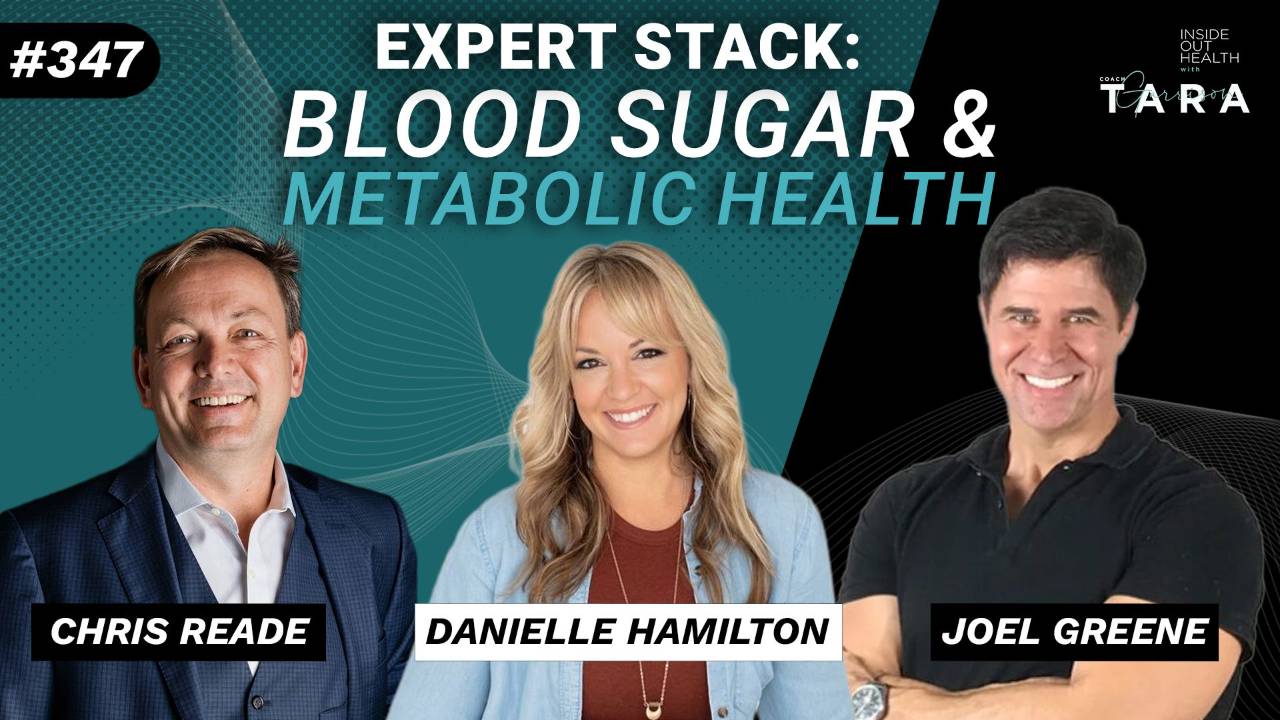


Your blood sugar isn't just about sugar — it's tangled up with your gut, your immune system, and how your whole metabolism runs. This episode pulls together three conversations that build on each other, from one guy's simple fix to the bigger picture behind it all — meet your three experts below.
Most people with type 2 diabetes are told it's a forever sentence. Chris Reade was one of them. In 2017, his A1C hit 9.1 with zero warning. He refused medication, did the research, and built a food system around the science of soluble fiber. Six months later, his A1C was 5.5. Seven years later, it has never gone back up.
Danielle Hamilton is a Functional Nutritional Therapy Practitioner & Restorative Wellness Practitioner who specializes in blood sugar regulation & digestion. She became interested in blood sugar issues when she learned that Insulin Resistance was at the root of her PCOS. She was able to reverse her PCOS, cystic acne, PMS & weight loss resistance by reversing Insulin Resistance.
Joel Greene is the very first gut-health protocol teacher, the original biohacker that utilizes the immune system and the family of insulin hormones to create lasting health. Joel has spoken on other top podcasts such as Ben Greenfield’s Life and Cynthia Thurlow’s Everyday Wellness.
In this episode, you'll hear three experts connect the dots between blood sugar, gut health, and metabolism — starting with one guy's simple fix and ending with the bigger picture behind it all.
RESOURCES:
- Learn more about Chris Reade here: https://www.beatingdiabetes.
us/ - Chris Reade's Instagram: @beatingdiabetesus
- Check out the full conversation with Chris here: https://www.taragarrison.com/blog/chrisreade
- Learn more about Danielle here: http://daniellehamiltonhealth.com
- Danielle Hamilton's Instagram: @daniellehamiltonhealth
- Check out the full conversation with Danielle here: https://www.taragarrison.com/blog/daniellehamilton
- Joel Greene's Instagram: @realjoelgreene
- Check out the full conversation with Joel here: https://www.taragarrison.com/blog/joelgreene
CHAPTERS:
00:00 – Intro: the blood sugar & metabolic health expert stack
01:39 – Chris on his diabetes diagnosis
03:46 – The shock: A1C jumps from normal to 9.3
06:04 – What caused it: a parasite that wrecked his gut biome
09:53 – The research: soluble fiber studies since the 1970s
12:33 – Cutting sugar, ramping fiber, and an unplanned 25-lb loss
14:35 – Danielle's wake-up call: the PCOS/diabetes connection
16:05 – The "personality traits" that were really blood sugar crashes
17:00 – Recognizing a crash: brain fog, mood, the Snickers test
22:14 – How blood sugar works and the insulin resistance spiral
27:05 – Digestion mechanics: chewing and stomach acid
31:01 – Bile, fat digestion, leaky gut, and practical fixes
34:37 – Joel's framework: three metabolisms, not one
36:04 – Immune cell metabolism's link to fat, obesity, and cancer
38:28 – Why sugar isn't "just a calorie": Warburg metabolism
42:40 – The gut-immune axis: your body's biggest immune hotspot
44:46 – Bifidobacteria and Akkermansia: the gut-immune balance
48:18 – Sugar, extreme diets, and why they backfire long term
WORK WITH TARA:
Are You Looking for Help on Your Wellness Journey? Here's how Tara can help you:
- CHECK OUT HIGHER FITNESS APP: https://app.taragarrison.com/
- INDIVIDUAL ONLINE COACHING: https://www.taragarrison.com/work-with-me
- CHECK OUT HIGHER RETREATS: https://www.taragarrison.com/retreats
SOCIAL MEDIA:
- Instagram @coachtaragarrison
- TikTok @coachtaragarrison
- Facebook @coachtaragarrison
- Pinterest @coachtaragarrison
INSIDE OUT HEALTH PODCAST SPECIAL OFFERS:
☑️ Upgraded Formulas Hair Test Kit Special Offer: https://bit.ly/3YdMn4Z
☑️ Upgraded Formulas - Get 15% OFF Everything with Coupon Code INSIDEOUT15: https://upgradedformulas.com/
☑️ Rep Provisions: Vote for the future of food with your dollar! And enjoy a 15% discount while you're at it with Coupon Code COACHTARA: https://bit.ly/3dD4ZSv
If you loved this episode, please leave a review!
Here’s how to do it on Apple Podcasts:
- Go to Inside Out Health Podcast page: https://podcasts.apple.com/us/podcast/inside-out-health-with-coach-tara-garrison/id1468368093
- Scroll down to the ‘Ratings & Reviews’ section. Tap ‘Write a Review’ (you may be prompted to log in with your Apple ID). Thank you!
EPISODE TRANSCRIPT:
Welcome back to the Inside Out Health podcast. Today we've got another expert stack for you, and this one is all about blood sugar and metabolic health. I really wanted to put this one together because we tend to massively oversimplify things when we talk about blood sugar. It's like it's just about sugar, carbs, and insulin, and that's all there is to it.
And yes, obviously those things do matter, but there is so much more going on when it comes to understanding how well your body is actually managing glucose. And so I wanted to bring these experts to your attention as you're thinking about this, so you're getting points of view that aren't typically talked about when it comes to blood sugar.
So first you're gonna hear from Chris Reade. Um, he was on rather recently. I don't know if you caught that episode. But he had an A1c, HbA1c of 9.3, which is very diabetic. Um, and he was able to bring that number all the way down into normal ranges, and there was just one change he made to his nutrition.
Very cool, and I, I can totally see how that would happen, so wanted to highlight him. Then we're gonna hear from Danielle Hamilton. Um, she's gonna help us connect the dots between blood sugar regulation and digestion. And then Joel Greene is going to zoom us out even further into the relationship between the gut, the immune system, and metabolism.
So I love episodes like this where you start putting together the dots of seeing points of view from multiple experts, so it's not just this like dogmatic one way of thinking. It brings a lot to mind. So, uh, we will go ahead and get into it. Hope you enjoy this expert stack on blood sugar and metabolic health.
Chris, let's talk about diabetes. And I love... You know, I wanted to have you on the show because I love that you approached, you I'll let you tell your story, but I love that you approach this in a way that not many people think about, and that those of us who understand nutrition are like...
I, I read your story and I was like, "Smart." So let's, let's, let's let you tell it.
Sure.
Can you talk about your experience and what leads you here today?
Yeah, yeah. And, and thanks for having me. And I, uh... So for me, I think a There's two reasons I think that approached, uh, what I did the way I did. And so for me it starts, uh, way back in 2017. Um, and my daughter was little, uh, which definitely played into a, a role in it at the time.
And, uh, I was pretty healthy guy. I played sports all the time. Um, I I felt fit. I didn't feel like I was sick at all. And, uh, of all the things that was gonna change my life, I never thought it would be, uh, an insurance renewal, but that's what it turned out to be And, uh, what ended up happening was
my insurance agent changed companies, and when he did he said, "Hey, I can't take your account with me, so you're gonna get somebody new." And so about six months later, I never get a bill. was kinda like, "Huh, should've gotten another bill." I got an initial bill, and it's been like half a year.
I should've gotten another bill. So I call my guy up and he says, "Hey, remember the part where I left for another company? Yeah, I can't help you, but I'll go ask the people who took over what it is." And he said, "Well..." Calls me back and he says, "Well, it's a good thing you're not dead 'cause, uh, they never finished processing your policy.
You don't have any life insurance." And, uh, I said, "Oh, wow." He said, "But the positive is you get to redo it with me." I said, "Okay, great." So we did it. And as you know, or you, you... I'm sure some of your readers, uh, listeners will know, uh, when you do that kind of thing you have to do a, a blood screening, right?
And I'd had one the year before, 10 months earlier, not even, not even a year, and, uh, totally clean. You know, normal A1c, normal most things, which is fine. Anyway, uh, so I go do the second one, and now my A1c has gone from normal to 9.3, and I didn't even know what an A1c was at the time.
I had no clue.
Which diabetes, if
Yeah
found it familiar, for sure.
Right. So normal, normal for most people ends at 5.7, and diabetes really starts at seven. And for most people, they don't have the experience I had. Most of us, they... You know, you go to your annual checkup and the doctor says, "Hey, Chris, you might wanna start taking it easy on the sugar," blah, blah, blah.
Like that's what most people get. I didn't have that experience. For me, and I think this is... You asked the question, like what made me do this. It was such a shock. Like I went from 10 months earlier totally fine to now you're a full-on diabetic, and I was like, "Oh my God, what?" And, uh, and I was like, "I can't be a diabetic." And the doctor, she was very nice.
So I went to see this doctor and, and I hadn't seen a doctor, like a lotta guys, hadn't seen a doctor in a long time. And, uh, and she says, "Look, this is a progressive, incurable disease. You're gonna have this the rest of your life, and we're gonna start you on some metformin.
And if that doesn't work, we're gonna hit you up with some insulin, and we'll go from there." And I was like, "What? Time out. What?"
Mm-hmm.
And, uh, so I think that shock is part of what made me just go, "No, we're gonna find another way."
Mm-hmm.
I think that was part of it. And the second thing, um, I'm, I'm a entrepreneur, I'm a self-employed person, I've been since basically my whole adult life, and so I'm not temperamentally suited to following the rules particularly well.
Right.
And so I And I'm a tech person, so I, I, I'm a systems person. I wanna find a new system. So that's why I went and I did a lotta research and came up with the solution that's in my book, um, and, and implemented it successfully. And within four months I had my A1c under, uh, seven, and by the time six months had rolled around it was 5, 5.2, 5.1, something like that, which is nice and normal.
And, uh, it's never been above that really since. Um, and so that's the, that's the story more or less.
So before we, you know... I know everyone wants to know what you did, but
lot of details, yeah
gonna tell you yet. I, not yet. I have a question. Did you ever find out like what, what, what caused it to jump so high so quick? Like, I
Well, I'll tell you what, I've had a lot of time to think about that.
Uh-huh.
And I I had been, um, I had, uh, I had gone to go buy... I'm a motorcycle rider, and I had gone to buy a bike up in Chicago, and we had gone to this, like, one of these, like, experimental food kitchen things that's, like, in an alternative location and all this kinda stuff.
A couple nights earlier, I ended up getting
Mm
intestinal, uh, you know, intestinal parasites and all this stuff. And the first doctor didn't know what to do with it, and they gave me this, um, kind of, uh, nukes your gut bacteria, uh, type of pills, like these super powerful antibiotics, which didn't do squat 'cause it was an intestinal parasite.
And, uh, once I realized what it was, took, like, two seconds, like, one pill and, like, no problem. But, uh, I'd had my gut biome, you know, napalmed, you know, like
Mm-hmm
six months, eight months in between when I had that first
Mm
the second. And I think my
Mm-hmm
bacteria, my biome changed.
Mm-hmm.
And I think that I was able to process sugar more
Yep
before.
Yep.
And then when that got kinda recolonized, it, it didn't have the
Yep
strengths to it.
Right.
And that think that's what it is. I have no that, but
Right
very coincidental timing, so I
Mm-hmm
that's what happened.
Mm-hmm.
Um, and obviously I've had a lot of time to read up about your biome and I,
Mm-hmm
pay a lot attention to that kind of stuff nowadays.
Mm-hmm.
And, um, I, I, it, it kinda
Yeah
to, to how that
Yeah, makes sense to me. Wow. Thanks for sharing that. That's a
Yeah
insight for people as well, in addition to what you actually did. So, okay, we won't make
Well, and I will say, if you Google up, you know, "Hey, I didn't have... My A1C was normal and now it's super elevated," and if you Google that sort of thing up or ask ChatGPT what that is, they're gonna say you have a reasonable chance of having, uh, pancreatic cancer, and that scared the living hell out of me.
Like you said, my daughter was five or six at the time.
Right.
And I was like, "Oh, my God." And I went to a, a GI person and I was like, "Hey, I want you to do an MRI," and he's like, "You know what the odds of you having pancreatic cancer are?" I was like, "Yes, 1 in 110. I do not want to be Mr.
110."
Yeah.
"So can we please do this?"
Yeah.
And it turned out to be normal, and, uh,
Mm-hmm
but it was definitely, it scared the
Yeah
heck out of me, which I think really gave me the oomph to
Mm-hmm
make a change.
Mm-hmm.
as it turned out, what I stumbled on by doing a lot of research turned out to be so easy that I, I don't even... There's, like, no effort to it anymore. It's just part of my natural rhythm.
Mm-hmm.
I'm here on vacation in a, in a different city that I normally live in, and I've had no trouble sticking to my normal way of living and eating.
Nice. Yeah. it's always changing patterns is hard, but once they become your new normal, then it, they're kinda easy 'cause it just feels normal, right? Um,
Yeah, and I write a lot about that, like, habit stacking and,
Mm-hmm
forgiveness and all of these other of things that you kinda use as tools to stick with things.
Mm.
Um, and they make a, they make a big difference. In my industry, kind of a, a watch word or a watch saying, if you will, is, uh, ease of use equals use. If it's easy, you'll do it, right? So when we build software, if we make it simple, you'll do it.
If we make it complex, you probably won't do it.
Mm-hmm.
And I felt the same way about finding a new way to live, um, was that it had to be simple. I had to be able to follow it anywhere, anytime.
Mm-hmm.
Um, traveling, um, at home. Like, it had to be easy. If it wasn't easy, I wouldn't have stuck to it.
Mm. All right. So you went full tech entrepreneur research, uh and what did you find?
Well, here's what I found. This is what's so funny about science, right? Science, uh, a lot of answers are already out there and have been out there for a very long time, and you don't realize it until you go look for it.
Yep.
So have a whole chapter called, uh, Studies bet my life on, because I did. Um, and they are mostly about studies that start in the 1970s.
Yeah.
So early in the '70s, um, there's a handful of studies that basically show that soluble fiber, not... And, uh, we'll get into the difference between soluble and insoluble fiber. But soluble fiber, uh, has the ability to slow digestion of sugar and reverse diabetes. Um, and so this has been studied, and studied, and studied for we have longitudinal studies that start in the '90s that are still going today.
There's a lot of people who have written about this. Interestingly, most American physicians don't know this or have heard it in school, and they're like, "Oh, yeah, I heard that once," right? And
Right
really realize how prevalent the studies are showing and the many, many people who have put this into action. I'm hardly the first, by any means. Um, it, it basically means when you digest things that have sugar in them, your body will turn around and take the sugar out of those products, carbohydrates or actual sugars or whatever, and turn them into glucose in your blood.
And that glucose in your blood, if your pancreas can't eliminate it using homemade insulin that it makes itself, then you get elevated blood sugar, and that's what drives your A1C higher is the spikiness of that. Well, what soluble fiber does, it slows down your digestion. So it's oatmeal, broccoli, beans of every type, um, chickpeas, like all that kind of stuff.
It slows down your digestion. And in slowing down your digestion, you never spike your blood sugar. And as a result, you basically put diabetes into remission by allowing your pancreas to have more time to kind of deal with things.
Mm-hmm.
Um, so that's what I discovered by reading up on what many other people had studied over many years. And then I said, "Well, all right. Let's try it."
Mm-hmm.
And I did, and it was amazing how fast and easy that was. I mean, it was a few months. It was not that big a deal.
Well, and not to mention that soluble fiber is food for your beneficial gut
yeah. Absolutely
and also some of them, the opportunistic ones. So I, I am curious about this. Like, when you first started increasing your soluble fiber, since you had this kind of, you know, A bombs gut microbiome, was that kind of a negative experience? Did you titrate up slowly? Or, like, what that go for you?
wasn't thinking, so
went for it
I was just like, "Let's go full Monty immediately," right?
Uh-huh. Uh-huh.
And, uh, and I cut all the sugar. I mean, that's a... You know, first of all, if you don't wanna take drugs and you have an elevated A1C, cutting added sugar out of your diet's table stakes. That's just what's gonna have to happen.
Right.
It's just... And it's, uh, the soluble fiber part is what turbocharges it. And so it didn't give me like... I don't really have, uh, you know, terrible gut issues, stabbing pains, any of that kind of crap.
Mm-hmm.
for me, it was actually really,
Cool
straightforward. Um, and you know, it happened to... I also happen to like a lot of those things. So, like broccoli and, and chickpeas, and hummus, and stuff like that, I love that stuff anyway.
Mm-hmm, mm-hmm.
So it wasn't... It was just saying, "Okay, let's, let's dial back all these added sugars and all this crap that I'm having, and let's dial up
Mm-hmm
soluble fiber that I was already having some and just didn't even really think too hard about it. and, you know, and I also... The, the interesting thing about that, if you wanted to drop a quick 20 pounds or 40 pounds, some
Yep
this is also the diet for you.
Yeah.
'Cause what happens when you eat soluble fiber is you feel full, so you don't end up eating. I wasn't trying to lose weight, but I lost almost 25 pounds. And I didn't feel like I had 25 pounds to lose, but I obviously did. And, um, I... That wasn't the goal.
I wasn't, like, watching what I ate in the sense of, like, portions or anything. I just went... Was like, "All right, we're gonna switch to the soluble fiber stuff," and magic happened. and so from that perspective, it's healthy for your guts, you
Mm-hmm
your microbiome. It's healthy for your sugar control, and it helps you maintain or lower your weight. And so
Mm-hmm
it's good all around. And I feel I am, uh, like, objectively speaking, I'm eight, almost nine years older now. I am in significantly better shape now than I was then.
One day, I hear this podcast. It was Megan Ramos on Dr. Fung's podcast. And she said, "PCOS is the diabetes of the ovaries." And I just, like, almost drove my car off the road. was like, "What do you
Yeah
diabetes?" Oh, my goodness. I actually skipped over all the the chapters on blood
Wow
because I thought it didn't pertain to me. I thought I was
Wow
"Who cares about this? This is like-" I'm like, "I don't have diabetes. I don't have to care about that." So I didn't know that type
Wow
diabetes is this spectrum, right? So we can
Wow
blood sugar dysregulation years and decades before it manifests into type 2 diabetes.
Right.
I would hear blood sugar, and I would glaze over 'cause that was complicated and boring. And who wanted to even learn about that?
Wow.
And meanwhile, what I was resisting was, was really at the root of all these things.
Mm.
So I look back and say, "Okay, there I have to have symptoms of blood sugar issues. I just don't know what they are because I don't
Wow
what blood sugar symptoms look like." And maybe I was the only one, but maybe not, because the only symptom I knew about type 2 diabetes was something about amputations, something about blood
Wow
'cause of the patients that I worked when I was a speech therapist.
Wow.
So not knowing about that, I was like, "Okay." I, I dove into the, you know, all... I went back. I, I read all the chapters of the books that I had skipped, and I was like, "Oh, my goodness. This is me."
Awesome
I thought that A lot of blood sugar issues that I have had, uh, I thought were personality traits. So I thought I was just the hangry friend.
Mm.
I thought I was a foodie, and that's why I needed to carry food with me. And that's why I used to eat before I went out to eat. It wasn't because I was a foodie. I used to hate to be I just hate being hungry.
Wow.
Hate being hungry because it was a blood sugar crash, because your was going through a crisis. So all these things, I thought I was a breakfast person. I wasn't a breakfast person, I just liked to eat breakfast 'cause I'd wake up shaking and hypoglycemic.
Right. Yeah.
I thought these were all personality traits, and I was... And, uh, I mean, a a sweet tooth. Like, I used to say, my line was, "I don't have a sweet tooth, all my teeth are sweet."
Right.
That was my motto, you know? And I didn't know that that was blood sugar dysregulation.
Wow.
So how it showed up in me was I had low blood sugar, but I had high insulin. My insulin was pushing down my blood sugar too low, so I used to have to eat all the
Mm
to keep my blood sugar because the, like I said, that the feeling of the hunger in my body was really low blood sugar, and we can go into that. But how it showed up for me was that dizziness, shakiness, anxiety, irritability, sort of like this, your head feels like a balloon.
Um, brain fog, difficulty concentrating. And then a lot of people get other symptoms, and usually these show up when you're hungry or when a meal is, like, delayed. So let's say you have a meeting and it's going through your lunchtime.
Mm.
It's like you can't concentrate. You start maybe heart palpitations, headaches, cravings, intense, urgent hunger.
Mm-hmm.
Um, feeling, uh, the, getting sweaty, um, clammy. Uh, some people get, they get cold. I mean, there's all sorts of symptoms. But you should not be... Basically, the take-home message is that your hunger should feel like, "Oh, I could eat." Like, "Oh, oh,
Right
I'm pretty hungry."
Right.
But you shouldn't feel different.
Yeah.
You shouldn't feel like... You you honestly should be able to feel like you could still be on a podcast and talk and
Yeah
problem solve and finish that work meeting
Yeah
not change your mood. I mean, if your mood changes when you're hungry, if you turn into Joe Pesci in the Snickers
Mm-hmm
you're probably, your blood sugar's dysregulated, right?
Yeah.
So that's how I learned about all that and where I fit in, and those are just the early signs. So I'll let you jump in 'cause that's a lot.
Mm. So good. Like, okay, so I mean, the, the, that's such a, like, mic drop about, "I thought they were personality traits." Oh my gosh, so many people can relate to that. 'Cause how many, like, how many memes do we see about hanger? About like, "Don't mess with
shirts
I'm hangry." Yeah. And shirts and
Yeah
it's just like this thing. And it, you're right, like, it's, it... I don't think people It's like you're not just, like, it's not some genetic, like, you're hangry, you know? It's
It's like, "Oh, I'm the hangry friend. Oh, we need to get Jessica something to eat because, like, God forbid," you know? We can all picture those people. And unfortunately, that's the people with that, that, that crisis happening in their body.
Right. And I used to be like that too, like back when I was overweight and, you know, I, like the, all of... To, to think that, to hear you say what you just said, for me back then, when you said that, uh, you shouldn't feel different in your mood or energy levels, I would have kind of probably not believed you.
Like, that's how real that was for me. I was like, "Yeah, no, she's just saying that." Like, I would've been like, everybody feels kinda whack when they're hungry. Everybody feels kinda like in a bad mood when they're hungry. That's how, how, uh, like it would've been hard for me to believe.
And now, especially after doing keto and intermittent fasting and eating healthy, like, no. If you, I'm just saying, if you're listening this and you were wondering if she's, like, exaggerating or if that's not really a real thing, it is a real thing, and both of us have lived on both sides of that.
And now it is. It's, it's a physiological hunger, just in my belly. It's not like I can't operate, I can't, like, communicate. I'm not, like, sitting there... the last thing I'll add on from my perspective is just it's when you're, like, kind of with food. Like, it's just
Mm-hmm
when is this freaking gonna be over so I can eat? Ugh, it's like this urgent, like, just everybody shut up. Make the meeting end now. Like, that goes away. It does, so I just wanted to back that one up. Okay.
Thank you for sharing that.
Let's
wanted to share one more thing
Yeah
like you, I wouldn't have believed myself either because what my reaction, I used to hear people say, like, "Oh my God, I think I forgot to eat lunch."
Yeah.
And I'm like, okay. Okay, okay. Like, I have never missed a meal in my life. Like, how could you forget to eat lunch?
Right
I thought, I thought they were showing off or lying.
Right.
For sure, 100%.
Right.
So I totally relate to that idea that, like, there's no way.
way, no.
And I didn't... and you just don't think that you could be different because your experience has never been different.
Right.
I was always that breakfast person, 'cause I'd wake up and eat Special K and Count Chocula and Golden Grahams
Right
you know, like, I'd
Right
cereal and then have the spike. And then,
Right
I mean, I didn't have a gram of fat in my body and I maybe only had a chicken breast and maybe, like, two eggs.
Right, same.
That was the only protein I was for my whole childhood.
Mm-hmm.
like, what was I running on? I was running on sugar forever. And, like, that, I mean, obviously that's what we were told, but that's the result. You know, that was the result for me.
Okay, so let's hit on this, um, your blood sugar being low, this being an early warning sign. Insulin is kinda driving it too low. So I wanna hit on that. I guess, like, you know, you talk about this type diabetes spectrum. Could you maybe take us through the
Yeah
of what you might be experiencing as you get, you know, where the first early warning signs all the way to, like, okay, now it's starting to get bad?
You got it. So let's start with talking about, like, what does blood sugar really mean, because that was like, glazed over, and so just hang in with me. I'm gonna make it as simple as and as quick as, and painless as possible. So sugar is an energy source, and when we eat something, especially with carbohydrates, our liver actually puts more sugar into our blood, and then, or the carbohydrates digest and it increases the amount of this glucose or sugar in our blood.
Our pancreas, just a little organ, will sense this and be like, "Oh, blood sugar's going up. I like the blood sugar in this Goldilocks range." The pancreas doesn't like it too high, it doesn't like it too low, it likes it to be just right, and so it's gonna secrete this hormone called insulin, which one of the things it does is it takes glucose basically by the hand, it shuttles it into the cells of the body.
So it'll knock on the door like, "Hey, muscle cell, I have some glucose for you," and then the cell will be like, "All right, come on in." So the insulin is what does the job of, like, helping to escort glucose into the cells, for the most part. Um, sometimes it could go in by itself, but mostly it needs insulin to do this.
So insulin will start putting the glucose into the brain cells, into the muscle cells, liver cells, heart cells, all where it needs to go, and then fat cells. So that's how the amount of sugar, that's how insulin lowers sugar in the blood, because it's putting it into the body.
So it's not going anywhere, it's just moving locations, right? So that's how our blood sugar goes down. And like I said about that Goldilocks thing, our body likes to have a little bit of sugar, just about a teaspoon, floating around at all times for quick access to quick energy.
Mm-hmm.
And so we have other access to energy in our body. Like, I like to look at our liver like the refrigerator, so that stores glycogen or another form of sugar, and so that's also easy access. So when we use up the sugar in the blood, we should be able to just go into the fridge and grab some sugar from the liver and be like, "Oh, no problem." Like,
Mm-hmm
you run out of sugar from your meal, let's just dip into the liver glycogen. No problem. Or muscle glycogen, no problem. And then the body fat is stored energy. That's like the deep freeze though, right? So it takes a little bit more, um, energy to get that, but that's, that should also not be a problem, because I could go down my stairs, open up the freezer, and get into the deep freeze, right?
Mm-hmm.
So this is what we want the body to be... This is, like, the body's reserves. It's, has this energy because think about our ancestors. If, you know, the buffalo came, we didn't kill it, looks like we're eating body fat for dinner, right? So we should be able, like, we're set up as humans to be to go through food scarcity.
So the fact that we would have to eat every three hours doesn't necessarily make sense with our physiology, right?
Right.
Because we're set up to be able to not have to do that.
Right.
So if we are having to do that, it makes you question, like, okay, why do I have to eat so often then? What's happening? So oftentimes what happens is there's this metabolic dysfunction that starts happening, and usually once we, when we spike our blood sugar a lot, we get a lot of insulin.
And so we have these huge spikes of blood sugar, usually from, you know, refined carbohydrates in this crap food that they have everywhere, that they sell everywhere, and they push in our faces. And so we're getting these blood sugar spikes all the time. We're getting these big surges of insulin, and insulin takes longer to come down than blood sugar does.
Blood sugar comes down right away, but the insulin sort of hangs out a little bit longer, and so we get this sort of buildup of insulin levels over time. We need more and more insulin to do the same job, and we start to develop resistance to this insulin. So that's like, you know, the insulin's knocking on the door of the cell being like, "Hey, I have some glucose for you." It's like The Boy Who Cried Wolf.
It's like, "You were just here, you know? Like, I've had enough of you today." So the cells are like, "La, la, la, I'm not listening. Like, I've heard this message before, you know?" So we need more and more and more insulin to do the same job. And As the insulin starts building up in our body, the insulin is sending It's a hormone, so hormones send messages.
And so this insulin is sending a strong message to the body to store fat. And when we're in, to simplify it, when, when we're in a fat storage mode, we can't be in a fat burning mode. So the high insulin levels in our body are blocking our body from accessing the refrigerator, the liver, glycogen, and from accessing stored body fat.
So if you have stored body fat but no energy, it's an access problem. You can't access the energy that you
Mm-hmm
that leads you to be dependent on this steady stream of carbohydrates coming in through your diet. So that's why you have to eat every few because that's the only energy your body is perceiving.
Digestion, that's the last thing I wanted to hit.
Mm.
Yeah. 'Cause you're really big on the, on the blood sugar management and the digestion and helping people optimize their digestion when they shift into these low carb diets. Can you share any nuggets of wisdom for people on that?
Yeah, absolutely. And I think that's where a lot of people don't realize they get stuck where it's like, okay, I'm trying to lower my carbs, but when I eat fat, I have to like run to the bathroom
Yeah
get super constipated. We're gonna talk about poop, people, so strap in. so there's so many signs of, um, poor digestion and gut health, and a lot of people realize that, you know, gut health is important and they jump right to the gut. So they're like, "Probiotics," and, and
Mm-hmm
maybe some glutamine. Like maybe they know that.
Mm.
But, but we have to think about the fact that digestion is this north to south process. So anything that happens up north that gets disrupted is gonna affect the whole chain going down.
Mm-hmm.
So one of the things, crash course, we have to be in a rest and
Yeah
parasympathetic nervous system state in order for our body to start the process of digestion, to pump us with stomach acid and saliva
Mm
peristalsis, moving the intestines, moving things through the intestines.
Mm-hmm.
So if we're on the go, we're rushing around all the time, we are Or eating distracted, eating standing up in the kitchen over the sink like a rat, like I have been known to do. Um, that's a quote from Friends. Um, like rushing and like being busy and distracted while we're eating and chewing just a couple of times, we're not gonna get that complete breakdown of food.
We need to think, we're taking like a hunk of steak
Yeah
breaking it down into microscopic that are like a, a single amino acid. You can't see that with the naked eye.
Yeah.
A single molecule of zinc. Like, so we have to break down this food so much in to actually get the benefits of it. And so I see people trying to increase their protein, but they maybe don't have a taste for stomach uh, they don't have a taste for protein anymore.
Um, they aren't hungry in the morning. They, um, maybe feel this excessive fullness after they eat. The food feels like it sits in their stomach like a rock.
Mm-hmm.
Maybe they're burping or bloating shortly after eating.
Mm-hmm.
Maybe they have heartburn or indigestion, um, undigested pieces of food in their stool, chronic constipation, um, fingernails that break, anemia. These are all signs of low stomach acid, which is Well, I skipped over chewing a little bit. Um, chewing's super important, 30 times per bite. So, so, so important.
But then stomach acid, that's where we need it to break down the food, um, and also start protein digestion. It happens a lot in the because the stomach acid needs to get acidic enough in order to trigger this enzyme called pepsin to start breaking down proteins. So pepsin would digest us, because we're made of if it were active all the time, so it needs that acidity trigger to turn it on.
Mm.
So when we're not acidic enough, when we're drinking all these alkaline waters at, um, at our meals, or like chugging water so much at our meals, or eating on the go and the body hasn't turned on the stomach acid, then we are deficient in that, and we're gonna have this insufficient breakdown of the food.
When we don't have the stomach acid, it doesn't trigger the pancreas to produce enzymes, then we get even less breakdown of the food. Um, some of those enzymes trigger the gallbladder to release bile, the and we don't get that Mm-hmm enough or at the right time because we don't have this acid.
Mm-hmm. So stomach acid is actually like, I call it the linchpin Yeah, the digestive tract. It has to be really working. Um, and then we And then also, like, a history of a low-fat diet, a plant-based Mm-hmm even a standard American diet, eating these Mm-hmm seed oils that are everywhere.
Our, our bile gets sluggish and gunky. And think Mm-hmm bile like dish soap. So if you had, like, like, 20-year-old bile, it I dish soap, it's kind of like this gunky stuff. Mm-hmm. Try washing a sink full of dishes with that. You're not Right get very far. Or even people who don't have a gallbladder and are just getting, like, a couple of drips from the liver, you can't wash a sink full of dishes and get rid of all that fat, emulsify it all.
And so we need a good amount of Right dish soap to get rid of all that fat. And so all of these things could be happening and causing digestive issues. Um, with, with poor fat digestion we could see light or clay-colored stools, stools that float, stools that are shiny, um, immediate urgent trips to the bathroom, or the opposite, constipation.
Mm-hmm. So those are a lot of signs of poor gallbladder function or poor fat digestion. Headaches over the eyes, tension headaches in the back of the skull, dry skin, um, hormone imbalances. So you can see that this is, like, reaching further than just the digestive tract. And then we get to the gut.
Then we get to that gut lining. And so if, if the things up north are not dialed in, if we're not chewing, if we don't have enough stomach acid, we don't have the right fat digestion, by the time the food hits the small intestine where a, over 80% of it is supposed to be absorbed as little Right now we have this big hunk of steak that's just inflaming the tissue in there, and we're getting lack of nutrient absorption, and we're setting the stage for a lot of inflammatory issues like leaky gut and food sensitivities.
Because now the immune system's being involved because it's Mm-hmm call the, call the... sound the alarms, like, this big piece of steak is here. It's not supposed to be here. Mm-hmm. It's supposed to be, like, a couple of peptides and amino acids and B vitamins. Mm-hmm. that's how the immune system gets involved, and then you start reacting to every food.
And all of that sets the stage for a really poor balance of bacteria in your gut. Mm-hmm. And so we have to look at different strategies to help our digestion when we're increasing, especially proteins and fats, because most Totally already digesting carbs. Um, Mm-hmm but I mean, basic sit, breathe, chew.
That's what I say. So sit down. I always say sit Mm-hmm fine ass down at a table. This is what I struggle with. Um, breathe, so we wanna get into that parasympathetic. So a couple of deep breaths. Good intentions, prayer, Mm-hmm gratitude over your food, your water, um, this stuff is really powerful.
Um, but it also drops us into Mm-hmm parasympathetic. Um, eating meals, like, get rid of distractions, and then chew. Chew your Mm-hmm 30 times per bite. That alone will transform your digestion. Mm-hmm. And, um, you know, quick tip, apple cider vinegar before Mm-hmm helps to not only increase stomach acid, but also lowers the blood sugar Yeah from meals.
So I feel like I should be sponsored by apple cider vinegar. Yeah. But... And one quick misconception is most people think, "Well, I have heartburn or acid reflux." Mm-hmm. "I have too much acid." And 99 times out of 100, it's actually from too little acid. Mm-hmm. So you need more acid in the system, but you also need to work with someone because you may need Mm-hmm heal this Mm-hmm before you go dumping more Mm-hmm vinegar into your system.
So that's just 100%.
if, if we're gonna say there's three metabolisms in your body, just to name them, it's your human metabolism, um, and then it's the metabolism within immune cells, which we'll spend some time on here, and then it's the metabolism within the microbiome. those are three separate and distinct metabolisms.
Yeah.
And they, um, they all impact the body in different ways. Um, you know, particularly with, you know, kind of my focus, which has been an immune-centric approach, the metabolism within immune cells in many cases probably dictates the, the health of the entire body. I mean, it's, it's a, it's a, it's an unknown thing that...
It's known in immunology. Like, that's all you talk about in is shifting immune cell metabolism. But in terms of diet and just the general public, it's not even in the conversation. there's a practical outcome there, and the practical outcome there is there are simple, easy, basic things that anyone can learn to shift the metabolism within immune cells, and the impact is profound.
And that's been my interest all along, is, is... Because I, I came from you know, a, a corporate gig working 14, 15 hours a day, and I'd, I'd done fitness for 20, 30-plus years, and I just ran into the wall of time. And so things that have a massive impact that work, that kind of became my interest.
And so, you know, one of the practical outcomes of immune cell metabolism is just body fat. And, and it... When you look at, when you look at adipose tissue and you look at what goes wrong with it, there's... All roads will converge on immune cell metabolism. You look at obesity, you look at, uh, cancer, you look at, um, you know, umpteen issues related to adipose mass, even, even sarcopenia, and always comes back to the metabolism within immune cells.
Like you, now you've got too many of the wrong types of immune cells, and the metabolism in those immune cells is doing things we don't want it to do that's leading to all kinds of, kinds of phenotypes that we really don't want. And the fixes for that are surprisingly simple.
Like, once you understand that it is possible to guide, shift, and steer the metabolism inside immune cells with specific sugars, it... Well, first of all, you've been doing it all along. Everybody has, they just didn't know it. So sugar intake is one of the primary ways to and by that I mean sucrose, I just mean, you know, the junk sad American diet.
One of the, one of the never talked about problems with that is that you're unknowingly, unwittingly shifting immune cell metabolism towards, um, what favors an obesogenic state, an oncogenic state, um, a gut dysbiotic state, and it's sugar. Well, you can take that same notion and take different types of sugars.
So you can take trehalose, you can take D-mannose, you can take turanose, all these different types of sugars, and once you understand how they work, there's subtle differences between them that impact immune cell metabolism, and you get some nifty little tricks to create a better probability of getting the outcome that you want.
So if it's obesity or if it's body fat, you wanna, you know, you want fat to not be inflamed, adding, um, mannose into the picture and ribose and doing that in a fasted state, you're actually creating these probabilities of targeting immune cell metabolism and, and just helping the equation down that road that you want it to go.
Mm-hmm. so you're saying it's not just directly eating sugar, you eat in
Mm-hmm
and now you have extra body fat stores. You're looking at it way deeper than that, and like how is that impacting the the function of the immune system that creates a more, higher probability of being obese, right, which I love. So can you share a little bit more, like what happens to the immune cell when you eat sugar and sad diet?
Yeah, the, and that, and that ties into the, you know, is a calorie just a calorie argument because one school of thought is that a calorie is just a calorie and sugar is just a calorie.
Right.
But once, once you pull that into the lens of immune cell metabolism, it's not. Not at all, because sugars in in particularly sucrose, um, impact the metabolism within different types of immune cells, within T cells, within macrophages. These are just different types of immune cells. And the thing to understand is that the immune response has to, in essence, operate just like cancer, if you think about it.
Okay, so what has to happen when there's a major insult to the immune system? You need a bunch of cells to proliferate rapidly, okay? They're immune cells, but you need, you need to all of a sudden you need to create this signal state that's inflammatory by its very nature, okay?
So the entire inflammatory side of the equation in terms of signals needs to be turned on. You need interleukin-1B, tumor necrosis factor alpha, you know, interleukin-6, all these inflammatory signal cascades. And then the cells involved require a lot of rapid energy, so they cannot rely on, um, they can't rely on OXPHOS.
They, they need Warburg metabolism to spin up. That's where they get the juice from. Well, what's the fuel for that? It's the same as a cancer. It's cancer cells spin up on sugar. Well, so do immune cells.
Mm.
That's where they, that's where they get the juice to rapidly proliferate. You know, cancer does the same thing. Cancer relies on sugar, rapidly proliferates. So they, they utilize the same engine in order to proliferate, and that's what gives them the juice to drive the inflammatory onset. That's not bad.
That's, that's actually essential. That's a good thing. In fact, uh, the practical application is post-workout. So post-workout, that's exactly what we want. You know, the old, the old post-workout hack of, hey, have something really sweet with your whey protein
Mm-hmm
you know, the ethos, the bodybuilding ethos used to Well, that helps drive, you know, amino acids into the cell.
Mm-hmm.
The other side of the equation is it actually helps inflame the heck out of you because, um, the immune cells that need to be recruited in post-workout, the inflammatory side, that's what you need.
Yeah.
That's great. Okay?
Wow.
It's not so great if you're talking about, um, adipose mass and you're talking about inflamed fat. So with inflamed fat, the reason it's inflamed is that you have way too many inflammatory immune cells in there, way too many inflammatory macrophages. You have a, you have a population density problem.
Like there's too many, too
Mm
that's out of balance. And what do they do? They recruit. That's what inflammatory immune cells do, is they recruit other types of immune cells. So they're putting out signal cascades, and those signal cascades are all inflammatory by their nature. That's, that's absolutely fine in, in the, you know, post-workout or, you know, you get a cut or something temporary that leads to a resolution.
Mm-hmm.
That's the worst thing possible in an ongoing state. That's the, that's the worst thing possible. And so you see with obesity, um, and a lot of other issues, you see inflamed fat that's characterized by massive populations of inflammatory immune cells putting out inflammatory signals, and, you know, never mind the, the, the problem with weight when you, when you go down that road.
One of the, one of the reasons that fat and cancer are so closely related is that fat cells and cancer cells share a lot of similarities. Um, they have an infinite capacity to reproduce, um, and when you sprinkle in massive inflammatory signals, which tends to go with a hypoxic state, so you, you stabilize hypoxia, you stabilize HIF1, um, and you have basically this, this perfect recipe that's oncogenic in its very nature.
It's, it's cancer-promoting in its very nature. So
Mm-hmm
that's, that's all comes back to the metabolism within immune cells.
Wow. Yeah. Thanks for laying that out. Let's, um, let's shift a little bit into kind of so since we're hitting metabolism, you know, um, and the gut is obviously such an area of expertise for you, like can we shift into maybe, maybe we can segue with sugar, but how the gut microbiome and sugar and other foods we're eating and all of it, how this uh, let's bring this piece into the the gut microbiome in terms of what we think of, you know, we say your metabolism, so we just talk about one.
But how is the interplay between our food, sugar, immune system with our gut microbiome impacting our health?
Mm-hmm.
That's a pretty loaded question. How isn't it? But...
Yeah. Yeah, that's true, yeah. Yeah. Uh, no, it's a good question, though. It's, it's, I think it's actually a foundational question. Um, it, it's just been underserved, I think, in terms of some of the answers that are there. So the, the, the first thing to consider, everybody wants the same thing.
Everybody wants real health that lasts. we all, it didn't, doesn't matter what your dietology is, everybody's after the same thing.
Mm-hmm.
And so if that's the goal, we can all agree, um, one of the things at the top of the list that you can't take off, like makes the top of everybody's list, is the gut-immune axis
Mm-hmm
the, the, the immune system, the largest number of, of immune cells in the body is in the gut. Largest, largest number of macrophages is in the gut. And it's the place where, the place where foreign matter first meets the human body. It's in the lungs, it's in the mouth, and it's in the gut, and so that's where the immune system first has to do its thing in terms of distinguishing self from non-self.
And there's this, there's this kind of interplay that has evolved between our human cells, between... It's kind of a three-way, um, game. It's, it's human cells interface with, um, bacterial cells, and those interface with immune cells. All three of them interface, all three of those, and that's where the three metabolisms really comes front and center.
And so what you see in the gut is that, um, we can kind of reverse engineer things that have to be in the diet of most humans based on what it takes to produce the optimal gut immune axis. And so you have to begin with Bifidobacteria, um, because when you look at the family of Bifidobacteria, it is so involved with the human immune response and shaping the human immune response.
It's involved in antigen sensing. It's involved in ratios of T cells. I mean, it, it's just, it's tough to, it's tough to make a case not for it. Now, you know, the, the contrarian will say, "Well, the Hadza doesn't have Bifidobacteria." And so the answer to that is that, that that's very similar to like the argument would be that, you know, um, there are functions performed by Bifidobacteria that perhaps other taxa of of bacteria can, can perform, but most people are not adapted to have those.
The vast majority of humans today are adapted to have Bifidobacteria directing and controlling the immune system. So, so, so the, the family of Bifidobacteria is at the heart, at the heart of the gut, of the gut immune axis, and the, the downstream interplay of that drives a lot of things.
Like, you can, you can look at wonky ratios of different species of Bifidobacteria, and you can explain autoimmune issues like arthritis coming directly from that. And so what you'll see is that when you're over-represented in, in certain types of bacteria in the gut, let's say, um, you know, the, just, just things that we don't want, they are...
The metabolism within those is producing, um, downstream metabolites or molecular-associated microbial patterns, MAMPS, that ultimately is triggering different aspects of the immune system. And restoring Bifidobacteria to optimal ratios can do things It can change the ratios of T cells. You can get less T17s, more TH1s, and you can see amelioration of things like autoimmune issues.
So what goes hand in hand with that is that bifido seems to act as a controller on other essential bacteria. So the other really important bacteria in there is the gut, um, mucinphage or akkermansia. Mm-hmm. And I wrote a lot about that in my first book. And in, in my first book, nobody really kind of knew about akkermansia and the, the goal was to give people a simple way to target bifido and akkermansia.
And then kind of what happened after that book came out is, is the, the, the, the entrepreneurial space jumped on that. And was just like, "Hey, you need akkermansia. That's all you need, you know? Get more." Right. And the, the problem with that is akkermansia you can think of as a starvation bacteria.
it proliferates, uh, by starvation, proliferates by phenols. Um, the basic thing with it is that it eats the gut mucus layer, and in doing so it triggers a whole host of responses. It triggers the muc2 genes, you get thicker mucus. It triggers, um, secretory IGA. You get, you get an optimal blend of, of the immune response between bifido and akkermansia.
But the controller, you can't have too much akkermansia because too much of it will, will eat through the gut lining. Um, the controller is bifido. So what bifido does is it keeps excess populations of akkermansia, um, from, from taking over. And so if you have optimal bifido, optimal akkermansia, then that's kind of the core of the gut immune axis.
That's not to say there aren't other players in there, but, you know, we can get what we want by targeting these two. And so what you find is that in reverse engineering, how do we do that?
You find a lot of popular diets at this age actually are maladaptive long term. So if you look at, um, well, how do we get optimal bifido? You kind of have to have certain types of carbs in the diet in order to do that, and when you eliminate those, you're gonna suppress bifido.
Certain types of diets will increase akkermansia, but at the expense of bifido, and ultimately long term, that's not a good thing at all. That you'll have people that point to that and, you know, they'll, they'll, they'll say like, "Oh, well you got more akkermansia, that must be good." Not necessarily.
Not unless you have bifido with that. Mm-hmm. So all that to say, um, sugar in this equation sort of adds fuel to the fire, suppressing, um, bifido bacteria, suppressing the ratios that we want, and essentially taking the essential aspects of the gut immune axis and really challenging that is, is probably the best way to put it.
You know, driving inflammation in the gut through, um, through the metabolism of bacterial metabolites, of bacteria that feed on sugar and ultimately produce an immune response. And so yeah. So the whole aspect of like sugar as a calorie, you gotta factor in the immune system and you gotta have to factor in the metabolism of immune cells because, um, you, you can't leave it out of the picture.
And, and a lot of the... So many of the issues we see today, gut dysbiosis and IBD and all that, you know, they're, they're related to years of poor diet and, and different types of poor diet. So you were Mm-hmm the SAD diet Mm-hmm and you wrecked your gut on that, and then you thought, "Well, maybe I'll do a carnivore diet," and you did that, and then you did that and you did it way too long, then you wrecked your gut more.
And so it's these extremes of diets that are really hurting people. Thank you so much for joining me on this episode of the Inside Out Health Podcast. I hope it's been helpful to you in your journey. If you think that it might be helpful to someone you know, please share it with them.
Please share on social media. It really helps me grow the show and reach more people with these amazing messages. And if you could be so kind as to rate the show and, um, possibly even leave me a review, that really helps. So, uh, much thanks in advance if you do that.
And yeah, please subscribe if you wanna hear more of this type of content. I have lots of amazing expert guests on the way. All right. Thank you.

Want One on One Coaching with Tara?
Click below to learn more about Tara's flagship 1:1 program HIGHER Coaching. Work directly with Tara on training, nutrition, personal development and biohacking!

Try Coach Tara App for 7 days FREE!
Learn how to train for results at home or in the gym, how to make easy, healthy recipes to achieve your goals faster, and explore the world with Tara as she helps spark shifts inside you to bring your best self out!
